
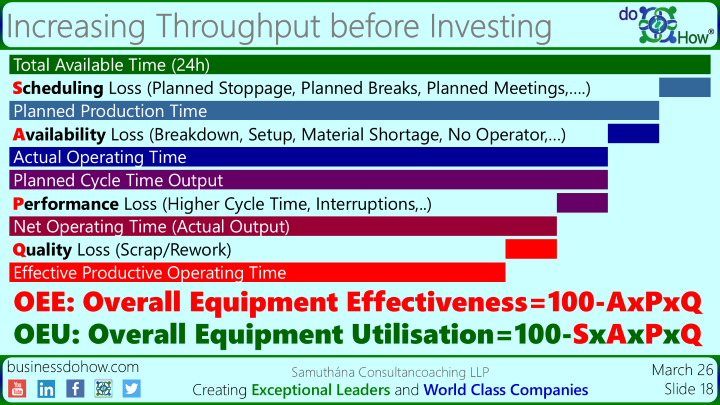
I am delighted to share insights into the strategies employed to bolster throughput in the manufacturing sector, a formidable challenge in the thriving economy of India, boasting a GDP growth rate exceeding 6%, ranking it among the foremost large manufacturing economies.
In situations where the order pipeline is brimming, if not overflowing, the inadequacy of throughput poses a significant challenge. The imperative to meet demand intensifies the risk to product quality, which normally is manageable through the implementation of a thorough control plan within contemporary manufacturing systems. This blog, however, is directed toward the singular focus on the imperative to augment production.
The initial step involved the identification of the constraint — pinpointing the machine overwhelmed by the highest volume of work in progress awaiting processing daily.
The primary and apparently straightforward measure undertaken was the extension of planned production time to 24 hours across six days, with a single shift reserved for preventive maintenance on Sundays. This approach encompassed three fundamental strategies:
1. Implementation of staggered shifts to ensure seamless transitions during shift changes daily.
2. Strategic planning of staggered lunch breaks, to keep the constraint running during the breaks each day.
3. Effective regular communication to the entire team, explaining the urgency of maintaining uninterrupted operations at the identified constraint daily.
The subsequent and somewhat intricate step revolved around maximizing operational availability through three organizational initiatives:
1. Establishment of a dynamic visualization system portraying material availability status over the next five days on a rolling basis, facilitating the provision of materials at least one shift in advance.
2. Development of a visual representation of the full kit status (either 100% or 0%) for the subsequent five setups, ensuring the comprehensive completion of external setup before initiating internal setup, when the constraint needs to be idling for the changeover.
3. Training a surplus of manpower, threefold of the necessity, to competently operate the constraint, perpetually ensuring the presence of a trained substitute by idling the non-constraint workplace of the substitute.
It is noteworthy that our concern regarding breakdowns was relieved by the reliability of contemporary machines, analogous to the evolution witnessed in automobiles. However, due diligence was exercised in reviewing spare part stocks to minimize Mean Time To Repair (MTTR).
The final phase involved addressing performance and quality losses, inherently requiring technical interventions. This inclination towards problem-solving, particularly in the technical realm, serves as a driving force in the manufacturing domain, despite potential yield constraints.
The strategic choice of utilizing Overall Equipment Utilization (OEU) as opposed to Overall Equipment Effectiveness (OEE) stems from the former’s comprehensive consideration of scheduling losses. A critical observation underscores the tendency, in various instances, to overlook availability losses and camouflage them on as scheduling losses, such as setup, operator, or material-related constraints, to attain an aesthetically appealing OEE, which is not possible in the case of OEU.
Since OEE can be suitably altered, we always preferred using OEU as a metric and our goal was to invest in new equipment, only when the existing capacity at 85% utilisation could not meet the demand. This motivated us to continually minimise the losses for a high productive time, before going in for investment. This strategy also helped us to keep our costs low because of us getting a throughput far higher than our competition. Finally, this was a robust approach even for people, since they were passionate about achieving 85% OEU on the constraint machine, as a kind of a challenge to creating new records, like in sports.
Above all this, the key to our success was creating an awareness and urgency among the entire team to get the constraint effectively working continuously. I remember one such situation when all the neighbouring operators would naturally leave their non-constraint workplaces on their own and attend the constraint even for a minor interruption. On this constraint we could achieve about 87% OEU every day for 6 days as we doubled our output in about 3 months. The best OEU, I have witnessed is 92% in some of the factories in Germany and Japan, where despite the high or highest salaries, the production costs are the lowest in the world. On the other hand, the OEU in the Indian manufacturing companies typically varies between 37% to 81% on the constraints, indicating a significant potential for improving the throughput and reducing the cost.
In conclusion, the initial and secondary phases with the maximum potential, predominantly entailing management and organizational facets, are often accorded minimal priority, even though they possess the maximum potential while demanding a highly coordinated teamwork. Our approach in navigating this terrain is incorporated by the principles encapsulated in our doHow® methodology. How are you navigating the landscape to augment throughput?
Happy Reading!