
Today, I am sharing my thoughts on the interdependence in teams, the core of a high performing team for accomplishing challenging impossible missions.
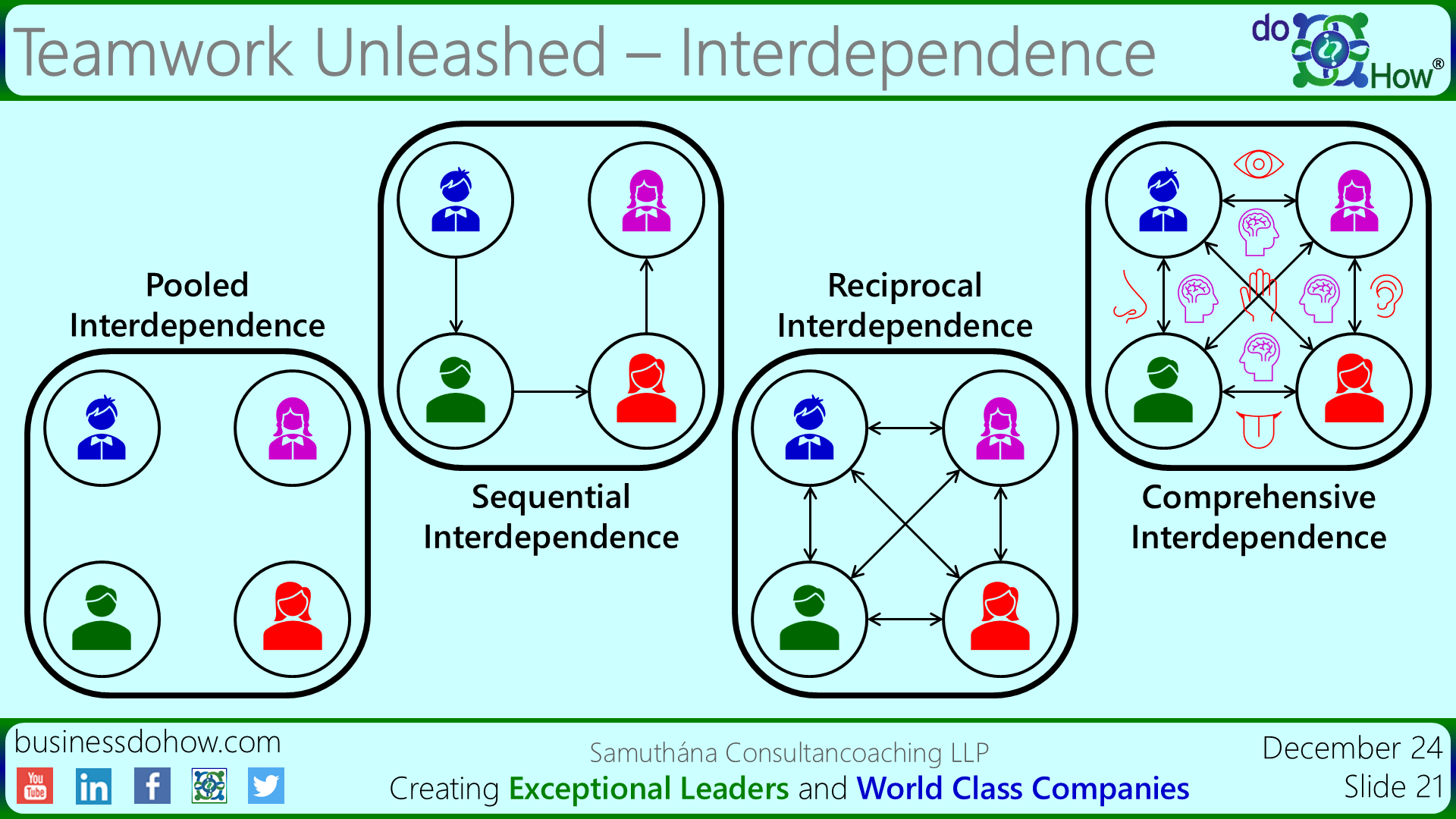
Task interdependence is the way the team members interact with each other for teamwork and for successfully achieving an outcome. The interdependence may be classified as Pooled, Sequential, Reciprocal and Comprehensive, depending on the context.
Pooled Task Interdependence:
Pooled interdependence exists when tasks are relatively independent of each other, and teams or individuals work on their tasks without significant interaction. The only connection between tasks is that they may share a common resource or goal. Each unit or team member work independently, and their outputs are combined to achieve an overall objective.
- In a potluck dinner, each guest brings a dish to share with the group. The success of the event doesn’t depend on how the dishes are prepared or who brought them; rather, the focus is on the variety, taste, and quantity of food. Each guest is responsible for their own contribution, and there is little need for direct coordination among them.
- In a large supermarket, many individual cashiers may be manning the different checkout counters, with each working independently to bill the products purchased by the customer. At the end of the day the sales will just be a sum of all the cash counters, with each cashier working independently to clear the customers.
- In a golf tournament, individual players of a team compete independently on the same course. Each golfer’s performance is measured individually based on their strokes and overall score. While there might be an overall competition for the tournament title, the golfers’ success is determined by their own performance.
Sequential Interdependence:
Sequential interdependence is a combination of pooled and sequential interdependence. In this type, tasks are relatively independent, but there is a specific order or sequence in which they need to be completed. While the tasks may be performed independently, the output of one task serves as the input for the next in a prescribed sequence.
- Consider a situation where a group of friends is preparing a multi-course meal together. Each friend is responsible for preparing a specific dish, and the dishes need to be completed in a particular order to serve a complete meal. For instance, one friend may prepare the appetizer, another the main course, and another the dessert. Although each friend works independently on their dish, the order in which they complete their tasks and serve the dishes is crucial for the overall success of the meal.
- In software development, there is often a sequential flow of tasks within the development lifecycle. For instance, the process might begin with requirements gathering, followed by design, coding, testing, and deployment. Each stage depends on the completion of the previous one, but within each stage, individual or team tasks may be relatively independent. Developers work on coding after the design phase is completed, and testers wait for a stable build to begin testing.
- In a relay race, each team member runs a segment of the race sequentially. The output of one runner (completing their leg of the race) serves as the input for the next runner. While each runner operates somewhat independently, the overall success of the team depends on the smooth and efficient handoff of the baton between runners in the correct order.
Reciprocal Interdependence:
Reciprocal interdependence is a combination of pooled and sequential, Over and above these for the success the team members must reciprocate with each other too. We might describe a situation where tasks are somewhat independent, yet there’s a mutual exchange of resources, information, or outputs among them.
- Imagine a book club where members independently read different books of their choice. During the club meeting, they share insights and discuss their respective books. While each member operates independently in their reading choices, the exchange of information during the meeting creates a pooled knowledge resource. Members benefit from a variety of perspectives, enhancing their overall reading experience.
- In a business setting, cross-functional teams from different departments may work on projects with interdependent tasks. Each team works somewhat independently on their part of the project, but there’s a reciprocal exchange of information and deliverables. For instance, the marketing team might provide data to the sales team, and the sales team might provide customer feedback to the marketing team for optimising the strategy.
- The basketball team’s success relies on effective ball movement and passing among players. A player may receive the ball, make decisions based on the game situation, and pass it to the same or another teammate. This exchange is reciprocal, as players share the responsibility of moving the ball strategically to create scoring opportunities.
Comprehensive Interdependence:
Comprehensive interdependence is a situation where tasks are highly interrelated, and the success of each task is dependent on either the successful completion of other tasks or the actual status of the other tasks. This type of interdependence often requires close collaboration and coordination among individuals or teams. The main differentiator here is the real time awareness of the overall progress made towards the end goal, by each of the team member, and when to pitch in with either pooled, sequential, or reciprocal interdependence, sometimes repeatedly, for the overall success.
Imagine planning a group vacation with friends. The success of the vacation is comprehensively interdependent on various tasks such as:
- Choosing a Destination: The destination choice affects accommodation options and activities.
- Booking Accommodations: Accommodation choices depend on the destination and the group’s preferences.
- Planning Activities: Scheduled activities depend on the destination and available accommodations.
- Transportation: The mode of transportation is tied to the chosen destination and planned activities.
- Budgeting: Budget considerations are intertwined with destination, accommodations, and planned activities.
In a business setting, the development of a new product involves comprehensive task interdependence:
- Market Research: Findings from market research influence product design and features.
- Product Design: The design phase is dependent on market research outcomes and influences manufacturing requirements.
- Manufacturing: Manufacturing processes are determined by the product design, and timelines are influenced by market demands.
- Marketing and Sales: Marketing strategies depend on product features, and sales depend on successful manufacturing and marketing efforts.
- Customer Feedback: Feedback from customers may impact future iterations of the product or inform new product development.
In soccer, comprehensive task interdependence is evident in team play:
- Defence and Offense: Defensive and offensive strategies are interdependent; a strong defence may lead to successful offensive plays.
- Midfield Coordination: Midfielders play a critical role in connecting defense and offense, requiring coordination with both.
- Passing and Positioning: Passing the ball is interdependent on the positioning of teammates, influencing the success of offensive plays.
- Goalkeeping: The goalkeeper’s performance is interrelated with the effectiveness of the defence and their ability to block shots.
I have seen that in the world class companies comprehensive interdependence is common while in the struggling companies it can be as low as pooled interdependence. I believe that every employee would want to contribute with comprehensive interdependence, irrespective of the stage of a company, struggling to world class. However, the lack of transparency and the boundaries created in a workplace are the main reasons for the struggling companies to remain struggling.
We use doHow® for execution excellence from vision to reality to create transparency and enable discussions and debates to break the boundaries for creating comprehensive interdependence to achieve challenging targets, especially in struggling companies.
How is your teamwork? Which level of task interdependence describe your teams?
Happy reading!