
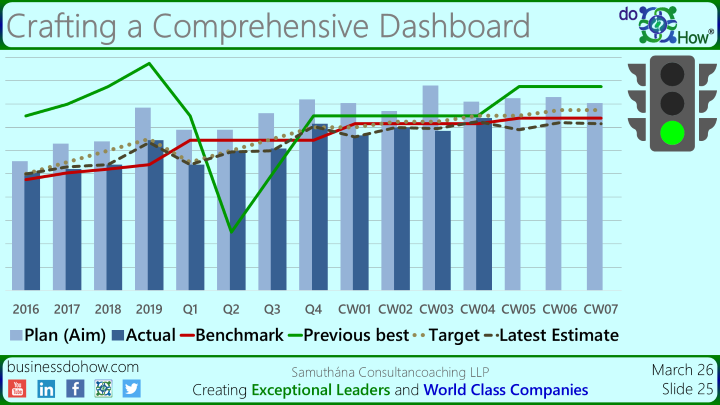
Greetings, budding leaders! As you embark on your journey to leadership greatness, it’s crucial to equip yourselves with the right tools for success. One indispensable tool in your arsenal is a comprehensive dashboard Crafting a Comprehensive Dashboard that not only reflects past performance but also serves as a guiding light for future endeavours. Let’s delve into the key elements that make up an effective dashboard.
1. Foundation: Past Performance Trend
Every present situation has its roots in the past. Therefore, understanding the past performance trend, presented consistently on the same scale, is fundamental. It forms the bedrock upon which we assess and comprehend the current scenario. After all, the present is merely an extension of the past.
2. Confirmation: Assessing Latest Performance
Once the trend is perceived, the next step is to assess the actual latest performance. This not only confirms the continuity of the trend but also provides insights into areas that might need attention or improvement.
3. Benchmarking: Like-to-Like Comparison
An extremely crucial piece of information is the like-to-like comparison benchmark. This allows us to assess the hidden potential within our performance and provides a clear picture of where improvements can be made based on industry standards.
4. Yardstick: Previous Best Performance
Our previous best performance serves as a yardstick for evaluating the already exploited potential. It provides a standard against which we can measure our current capabilities and identify areas where we can push our limits.
5. Assessment Tool: Agreed-Upon Targets
Agreed-upon targets become the assessment tool for evaluating planning, execution, and prediction performance. These targets, once set, guide our efforts and become the parameters against which we measure both failure and success.
6. Value Addition: Planning Gap to Target
Adding value to the report, an explanation of the planning gap to target helps assess the result-oriented culture in planning. It allows us to identify areas where strategic adjustments may be necessary for future success.
7. Critical Insight: Expected Yield from Plan
Understanding the expected yield from the plan, or the aim (which ideally should be at least 120% of the target), is vital. This information helps us gauge the ease of fulfilment and sets a benchmark for excellence.
8. Celebrating Success: Actual Performance Against Target
The ultimate outcome we all eagerly anticipate is the actual performance against the target. This is the moment of celebration, a testament to the hard work, strategic planning, and execution prowess of the team.
9. Deep Dive Culture: Analysis of Current Performance
To truly understand our performance, a deep dive into the current scenario considering the chances and risks considered in the plan is necessary. This analysis helps us cultivate a deep dive culture, where insights lead to informed decision-making.
10. Result Orientation: Gap Between Forecast and Target
Lastly, the gap between the current forecast and the target demonstrates the result-oriented culture in execution. It highlights areas where adjustments are needed, ensuring that we stay on the path to success. Setting the target based on the previous best, trend and the benchmark, continually pushes prosperity. The final signal indicates green.
In conclusion, a comprehensive dashboard tailored is not just a collection of data points but a dynamic tool that guides us, celebrates our failures and successes, and provides critical insights for continuous improvement. As you lead your teams, keep these elements in mind to navigate the complexities of leadership with confidence and vision. Success awaits those who plan strategically, execute diligently, and continuously strive for improvement.
How are your dashboards naturally driving thinking and generating insights for action?
Happy reading!