
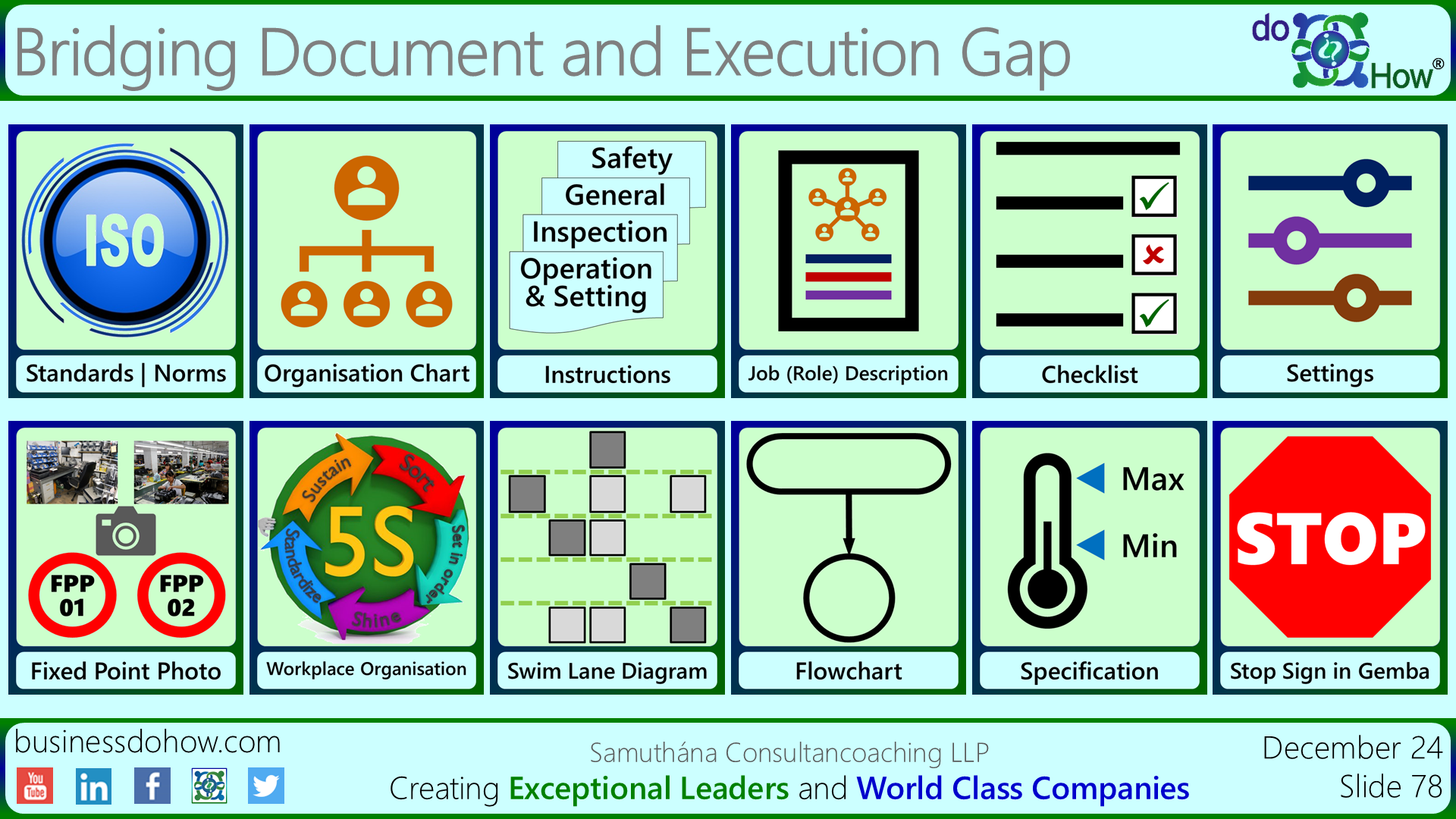
Despite the widespread certification of companies under ISO norms, Good Manufacturing Practices (GMP), World Class Manufacturing (WCM), and other quality standards, the gap between documentation and execution is glaring. Far too often, organizations boast certificates on the walls but falter in their daily operations, unable to translate standards into sustained performance. This disconnect stems from ineffective or poorly implemented Standard Operating Procedures (SoPs). SoPs are not just documents to satisfy auditors; they are the lifeblood of operational excellence. They are the detailed playbooks that ensure consistency, accountability, and measurable results. Without efficient and effective SoPs, even the best strategies crumble under the weight of inconsistency and miscommunication.
Imagine trying to bake a perfect cake without a recipe. You might have the best ingredients, but without clear instructions, the result could be a soggy mess or a charred disaster. The same applies to businesses and organizations striving for excellence: without a well-crafted Standard Operating Procedure (SoP), chaos reigns. Yet, crafting SoPs that truly drive performance excellence isn’t a matter of jotting down steps; it’s an art and science, demanding attention to critical success factors. This week let me explore these factors with the clarity of a sunrise breaking through a foggy morning.
- Linkage to the Purpose: The North Star
An SoP without a purpose is like a ship without a compass—directionless and doomed to drift. Every SoP must be linked to the organization’s overarching mission and objectives. It’s not about detailing tasks for the sake of documentation but about creating a blueprint for achieving meaningful goals. Ask yourself: does this SoP align with what we’re here to achieve? If not, scrap it and start over.
- Stakeholder Involvement: Building Bridges, Not Silos
Would you build a house without consulting the future occupants? Similarly, SoPs must involve all relevant stakeholders. From frontline workers to managers, everyone’s perspective is essential. This ensures that the SoP is not only realistic but also garners buy-in. When people feel heard, they’re more likely to embrace and adhere to the procedures.
- Integrated with Other Practices: The Orchestra Effect
A SoP should not play solo; it’s part of a symphony. Integration with existing practices, policies, and systems ensures harmony and avoids contradictions. Think of it as a puzzle piece—it must fit seamlessly into the bigger picture, enhancing cohesion rather than creating friction.
- Coherent to the Context: Tailored to Fit
Imagine wearing a tuxedo to a beach party. It’s out of place and ineffective. SoPs must be coherent to the organization’s specific and current context—industry, culture, and operational realities. A one-size-fits-all approach is a recipe for failure. Understand your unique environment and design accordingly.
- Based on Benchmarking: Standing on the Shoulders of Giants
Why reinvent the wheel? Benchmarking against industry best practices provides a solid foundation for crafting SoPs. Learn from the successes (and failures) of others to set a high standard. But remember, benchmarking is the starting point, for adding the best practices in small steps till the final destination.
- Relevant for Intended Outcomes: The Bullseye Approach
Every SoP must have a laser focus on its intended outcomes. If it’s not directly contributing to the desired results, it’s just noise. Clarity of purpose ensures that the SoP remains a tool for precision, not a source of confusion.
- Continually Improving and Up-to-Date: The Living Document
A SoP isn’t a stone tablet; it’s a living, breathing entity. The business landscape changes, and so should your SoPs. Regular reviews and updates keep them relevant and effective. Stagnant SoPs are like old maps—useless in uncharted territory.
- Practical and Achievable: Grounded in Reality
SoPs that demand the impossible are destined for the trash. They must be realistic, achievable, and grounded in the resources available. A Ferrari’s manual isn’t much use if you’re driving a bicycle. Keep it practical.
- Clear and Unambiguous: The Fog-Free Zone
Clarity is king. Ambiguity breeds confusion, and confusion leads to mistakes. SoPs should leave no room for interpretation. Like a GPS, they must provide explicit directions that are easy to follow.
- User-Friendly and Handy: The Pocket Guide
If a SoP is cumbersome, it will gather dust. Make it user-friendly and easily accessible. Whether it’s a digital document or a laminated card, ensure it’s always within reach and simple to navigate.
- Regular Training and Retraining: The Muscle Memory
A SoP is only as good as the people who follow it. Regular training ensures that everyone knows the procedure inside out. Retraining reinforces the habit, much like sharpening a knife to keep it effective.
- Flexible and Adaptable: The Rubber Band Rule
Rigid SoPs snap under pressure. Flexibility ensures they can adapt to unforeseen circumstances without losing their essence. Build in room for adjustments, but keep the core principles intact.
- Specific and Measurable: The Ruler Test
“Good” isn’t good enough. SoPs must have specific, measurable outcomes to track their effectiveness. If you can’t measure it, you can’t manage it, you can’t improve it. Define clear metrics and ensure the procedure delivers on them.
- Enforceable and Verifiable: The Accountability Factor
A SoP must have teeth. It’s not a suggestion; it’s a mandate. Clear quick (ideally within a couple of seconds) and simple (ideally visible) mechanisms for enforcement and verification ensure adherence. Think of it as a contract—binding and non-negotiable.
- Regular Adherence Control: The Guardrails
Finally, even the best SoPs need monitoring. Regular adherence checks act as guardrails, keeping the process on track. It’s not about micromanagement; it’s about ensuring consistency and quality.
Conclusion: SoPs as Catalysts for Excellence
Creating, implementing, and leveraging SoPs isn’t just a technical exercise—it’s an essential competency for every manager with strategic imperative. By addressing these critical success factors, you transform SoPs from mundane checklists into powerful catalysts for performance excellence. Like a well-oiled machine, they keep the organization running smoothly, driving progress and innovation. Ignore them at your peril; embrace them for your success.
When did you personally check one of your SoPs for driving execution excellence? How efficient and effective was this SoP?
Happy reading!
Excellent article Dinakar. Brings out a common weakness seen in many organisations. True, SoPs are the backbones
Great article! It’s insightful and highlights a crucial aspect of auditing. I’m curious to know how many auditors are actively following these practices and the kind of challenges they face in execution. From my experience, a few common challenges include misalignment between documented procedures and actual practices, resistance to change from teams, and time constraints during audits. How do you envision the current landscape addressing these challenges?”
The key is to first make sure that the SoPs are practical, add value, and are easy to understand and follow. Once this is done, training becomes essential before audit. In my opinion audit has to be at random with an element of surprise to check the compliance with necessary containing/correcting. In my opinion everyone in an organisation must be performing an audit for maybe just one or two aspects of a randomly chosen step in an SoP during a maximum of 15 minutes. This practice not only emphasises the need to follow the SoPs, but also makes the SoPs easily auditable.
Nice article. Key is aligning what one thinks, says , does and documents.