
I reflected last week on how structured collaboration and shared visibility can transform traffic jams into expressways of execution in my article ‘From Traffic Jams to Expressways: Resolving the Great Status Update Dilemma’. This week I am sharing my thoughts on another foundational pillar—unambiguous process documentation. If real-time trackers serve as the GPS guiding our journey, then robust process documentation is the map itself—clear, detailed, and trusted by every traveller. Today’s powerful low-code platforms offer us an extraordinary opportunity: to convert these process maps into dynamic, digitalised workflows that can be automated, tracked, improved, and scaled. But even more compelling is what lies ahead—an AI-driven future where learning, prediction, decision-making, and continual improvement hinge on the clarity and structure of these very process definitions. In essence, unambiguous process documentation is no longer a procedural formality—it is the stepping stone to tomorrow’s limitless digital intelligence. And yet, in far too many organisations, this goldmine of potential remains buried in archived files and unread manuals.
The Common Pitfall: Process Documentation as a Forgotten File
Sadly, most process documentation across industries is like a shelf of unused recipe books. Why?
- Ambiguity: Vague instructions like “handle the request” without specifying who, how, or by when.
- Inconsistency: Different departments follow their own version of the truth, or should I say ‘individually perceived’ truth.
- Lack of Practicality: Real-life exceptions, due to Murphy’s laws, or queries aren’t considered—making the documentation irrelevant.
- Zero Integration with Execution: There’s no linkage between what’s documented, what’s done, what’s improvised, and what’s learnt.
- Low Awareness and Accessibility: Documentation stored in shared folders, never opened after audits.
According to McKinsey, 70% of digital transformation efforts fail, and one root cause is the lack of clear, usable process definitions that frontline teams can trust and follow.
In our experience across industries, almost every employee creates his/her own unique shortcuts or workarounds, leading to:
- Process delays (by 30% or more)
- Reduced accountability (especially with adverse outcomes)
- Poor customer experience (executed flawlessly, poor outcome)
- Escalation of internal conflicts (erosion of leadership bandwidth)
It’s like building a house with no blueprint—everyone has a different idea of where the bathroom should be!
I am sure many of us have experienced the frustration of workplace documentation that exists only to tick boxes for certifications or to point fingers when something goes wrong. It may sound harsh, but that’s the reality in many organisations. This week, I want to share my experience in turning documentation into something living and breathing—as clear as a map, as accessible as a GPS app, and as easy to use as everyday tools like WhatsApp, Google Maps, LinkedIn, PhonePe, or Swiggy. When done right, it becomes an empowering tool that builds confidence, drives action, and makes digitalisation feel natural. That’s the essence of the doHow® approach to process documentation—keeping it unambiguous, practical, and ready for execution, by blending real-world human experience with digital discipline. Let me take a simple example of a Leave Application Process that exists in nearly every organisation, to explain what I mean by unambiguous process documentation based on my iterative learning from diverse assignments.
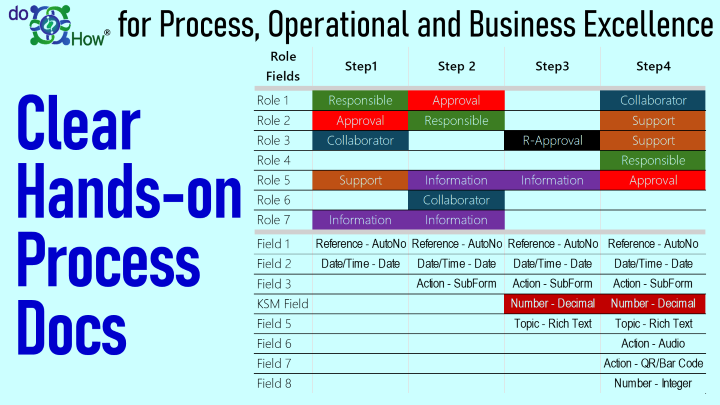
Applying for leave may seem simple, but questions like how long it should take, who needs to be informed, what to do about pending tasks, or how to handle changes can complicate things. The doHow® APP addresses all this by clearly documenting the process across four key areas, turning it into a smooth, efficient, and digital-ready flow that keeps everyone aligned.
1. Process Roles: Who’s doing what?
We identify the specific roles involved in the process, like the leave applicant, a digital application and the leave approver. Even machines or systems (like an APP) are considered as roles where automation plays a part. Each role is defined not just by title, but by their contribution to the process.
Link to a Sample doHow® Process Roles Report
2. Process Flow: What needs to happen and by when?
The leave process is designed to be as smooth and clear as a well-coordinated relay race, with everyone knowing their role and timing. It starts with the employee (the Driver) applying for leave (1-hour turnaround), followed by a quick note update on the available balance leave (< a second), and then approval by the manager (the Approver) within an hour—though about 5% of cases may need clarification. No ambiguity. Everyone knows what’s expected, when, and from whom. It’s like a relay race—smooth baton passing leads to a winning run.
Link to Sample doHow® Process Map Report
3. Process Data: What do we measure and track?
Key metrics are captured, such as Absenteeism and approval Turn-Around-Time are defined. All the data points, such as Name, eMail, Start Date, End Date, Reason, etc. are defined in a way ready for Digitalisation with Automation and Dashboards. This is where manual chaos turns into digital clarity.
Link to Sample doHow® Process Data Report
4. Key Success Factors: What makes each process step successful?
We define the Purpose, and the Input, Process and Output Success Factors, followed by mapping the step-specific Digitalisation Fields. Like a well-composed symphony, each player knows their part—and the sheet music is digital.
Link to Sample doHow® Process KSF Report
The Hidden Goldmine: Practical Process Documentation
When process documentation is done in a way like the doHow® way by defining roles, flows, data, and success factors with unambiguous clarity, it becomes:
A training guide for new employees A digital blueprint for automation A review tool for performance improvement A culture anchor for cross-functional alignment
It bridges the gap between “process as imagined” and “process as done”.
In music, even the most talented orchestra produces noise if they don’t follow the same sheet music. In business, it’s no different. Unambiguous, practical process documentation is the leader’s baton—bringing harmony, rhythm, and performance. Let’s stop treating process documentation as a compliance ritual. Let’s make it the gold standard for performance.
After all, clarity is not just power—it is the fuel for collective excellence.
How are you using your process documentation for increasing your bandwidth and for driving excellence with digitalisation?
Happy reading!