Last week my article ‘Why Some People Just Nod, But Don’t Really Mean It’ was about the passive resistance. This week I will try to analyse why and how such a situation gets developed. Running a business is actually simple.
You understand what your stakeholders (customers first, then employees, shareholders, partners, financiers, regulators and community) want. You figure out how to give it to them in a way that works for everyone. Then you try, tweak, and improve until it clicks. Like making tea—you know who likes it strong, who takes sugar, who prefers lemon. You boil the water, add the ingredients, and serve it fresh. Simple, right?
Then why do so many businesses—some with even just three people—become overwhelmed, sluggish, and full of frustration?
The answer lies not in the idea, not in the process, but in the people.
More specifically, in the mismatch of people types—and what happens when we ignore it.
When Competence Isn’t Enough
We often assume that if someone is good at their job, they’ll also be good at leading others or working in teams. So, we promote the consistent performer, put the best technical expert in charge, or hand responsibilities to the most articulate person.
But people aren’t machines. A screwdriver can’t do what a hammer does, no matter how sturdy it is.
Take an example. Imagine a small startup team:
- Raj is a Go-Getter—always ahead of the curve.
- Neha is a Dreamer—full of big ideas, short on follow-through.
- Manoj is a Victim Thinker—always finding why things didn’t work.
- Priya is a Reformer—constantly pushing for changes, even when unnecessary.
- And Ravi is a Loner—brilliant but avoids team discussions.
Now, ask them to build a new product, serve customers, and grow the business together. Chaos is guaranteed.
Raj feels like he’s carrying the team. Neha keeps changing direction. Manoj blames market forces. Priya questions every approach. Ravi disappears behind his screen.
Are they skilled? Yes, absolutely. But are they aligned? Not even close.
The Slippery Slope from Activity to Inertia
This mismatch doesn’t just create confusion. It saps energy.
Some people overwork, trying to hold everything together. Others disengage—watching silently, waiting to be told what to do.
That’s when the age-old wisdom kicks in: “An idle mind is the devil’s workshop.”
In companies, this devil doesn’t wear horns. It wears apathy, sarcasm, resistance, gossip. It shows up when people aren’t involved meaningfully or don’t see how they fit in. Their time may be booked, but their hearts have checked out.
Even worse, the overworkers burn out. They become resentful. And the very people who should be rowing together start pulling in different directions. The team feels busy—but the boat isn’t moving. This is lethargic inertia—the silent killer of progress.
The Real Reason Businesses Exist
Let’s go back to the basics. What is the purpose of a business?
Profit, of course, but it’s not just profit.
A business exists to increase stakeholder value—to serve customers better, empower employees, reward investors, uplift communities, and protect the planet. This is done by delivering:
- Relevance – solving real problems
- Timeliness – when it’s needed
- Price/Value – fair and worthy
- Quality – done right
- Convenience – with ease
- Service – with care
- Emotional/Social Appeal – making people feel connected
But value doesn’t create itself. It needs processes—living systems that:
- Measure efficiency through output metrics,
- Evaluate effectiveness through outcome feedback,
- Eliminate Mura (unevenness), Muri (overburden), and Muda (waste),
- Ensure zero defects, zero delays, and have the flexibility for agility.
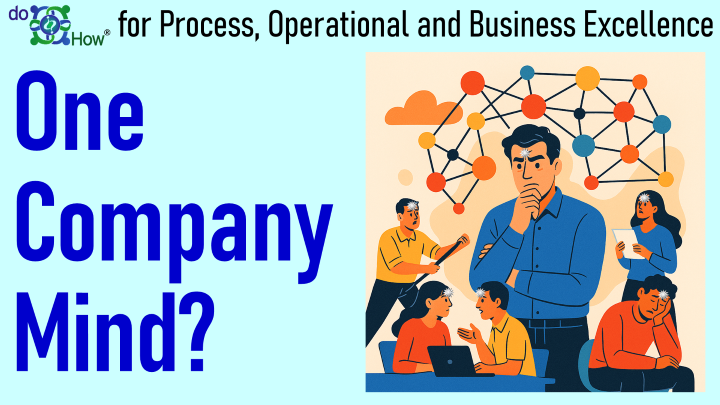
And yet, even these world-class processes can fall flat if people aren’t first aligned with the purpose and then share a common understanding of the expectations, current reality and the strategy for thinking as one company mind comprising of highly networked individual minds.
Before you can align people with the process, you must connect them to why the work matters. A disengaged heart won’t follow even the best-designed map.
From Confusion to Clarity: A Shift in Leadership
What makes this even more complex is our reliance on solo leaders.
We expect that one person to be the visionary, the coach, the planner, the motivator. But what if that person is a Loner? Or worse, a Victim Thinker?
No amount of training will change their core type overnight. Just like you can’t rush a mango tree to bear apples, people have patterns. The mistake is trying to fix them with generic leadership training, when what’s really needed is a redesign of how we build teams.
Imagine forming leadership teams instead of placing all bets on a single hero. A group with complementary types—like a Go-Getter to push, a Helper to support, a Sceptic to challenge, and a Dreamer to inspire. Each one adds value, and the gaps are covered collectively.
Now, the mismatches don’t create friction—they create balance.
The Road to Prosperity
When teams align with purpose first, they naturally evolve a common understanding and align with process. That’s when value creation becomes smooth, consistent, and joyful. People stop watching the clock and start watching the impact they’re making.
That’s when businesses stop spinning their wheels and start moving forward—enhancing not just profit, but also people’s lives and the planet’s future.
Because true prosperity is not just more money. It’s a holistic, inclusive evolution where People, Planet, and Profit thrive—together.
And the quiet, consistent path to this kind of evolution for making running a business as simple and easy as it should be? Well, some teams have discovered it already—through a certain reflective, experiential way of working that nudges alignment, purpose, and learning to unfold naturally, by first getting the leadership team, the ‘A-Team’ to understand their respective people types before embarking on a collective thinking journey for evolving that one company mind with a shared understanding of the expectations, the reality, the strategies, the tactics and the operations.
We call it the doHow® way.
How well is your leadership team aligned with the purpose and have one company mind?
Happy reading!