
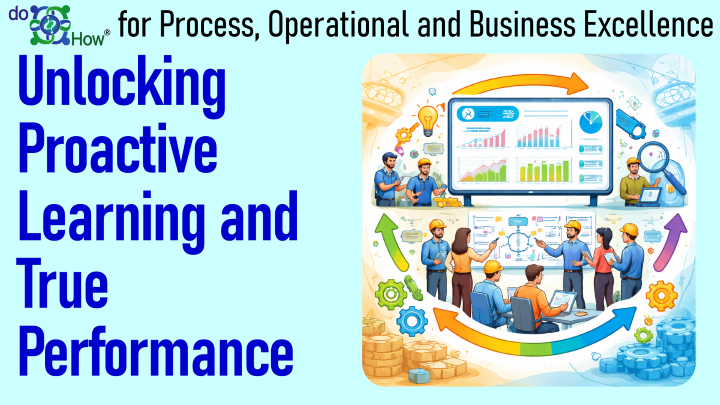
Expanding my last week’s article ‘When the Scoreboard Appears: Why Teams Stop Playing the Game’ I am sharing my opinion on some basic shift in thinking how performance is managed and appraised in organisations.
There is a pattern I have seen across factories—good ones, struggling ones, and even those aspiring to be world-class.
The moment KPIs and targets are deployed to individuals and teams… something subtle changes. Initially, performance improves. There is focus. Urgency. Movement.
But over time, something else creeps in.
People stop learning… and start managing numbers.
They stop improving the process… and start protecting the metric.
They stop playing the game… and begin playing the scoreboard.
And that is where the real loss begins.
The Hidden Cost of “Owning” KPIs
When a number is assigned to a person, it does not remain a number.
It becomes identity. It becomes pressure. It becomes something to defend.
And when something must be defended, human behaviour changes.
Problems are hidden, not surfaced. Shortcuts are taken, not questioned. Collaboration reduces, because success is now individualised. Learning slows down, because failure is no longer safe.
In manufacturing, where excellence depends on collective learning and system stability, this shift is dangerous. Because the system improves only when problems are seen clearly, discussed openly, and solved together.
But KPIs, when owned individually, quietly discourage exactly that.
A Different Hypothesis: KPIs as a Company Scoreboard
What if we did something radically simple?
What if KPIs were not given to individuals and teams…
But were held as a shared company scoreboard?
Not something to own. Not something to defend. But something to observe, learn from, and improve together.
In this model, people are not owners of KPIs. They are caretakers of the system that produces those KPIs. The shift may look small. But the behavioural impact is profound.
Because now…
A dip in performance is not a personal failure. It is a signal.
A deviation is not something to hide. It is something to explore.
A number is not a judgement. It is feedback.
And suddenly, the conversation changes.
From “Why did you miss your target?”
to “What is the system trying to tell us?”
The Rise of Proactive Behaviour
The most powerful shift I have observed in this approach is this:
People become proactive.
Not because they are told to be. But because the environment allows them to be.
When there is no fear of being judged by a number…
People start asking:
What can go wrong tomorrow?
What should we prepare today?
What patterns are we seeing?
Where is the next problem hiding?
They start anticipating. They start preventing. They start learning.
And over time, this builds something far more valuable than performance—It builds capability.
The Role of Leadership: From Target Setters to System Builders
This shift does not happen by changing metrics. It happens by changing leadership intent. Leaders must move from:
Setting targets → to building systems
Reviewing numbers → to enabling learning
Driving accountability → to developing ownership of the process
Because people do not create results. Systems do.
And people improve systems.
When leaders focus on strengthening routines—daily reviews, problem solving, standard adherence, cross-functional support—the system begins to stabilise.
And when the system stabilises, KPIs improve… quietly, consistently, and sustainably.
Rethinking Performance Appraisals
If KPIs are no longer owned by individuals, then what do we evaluate?
This is where most organisations struggle.
Because traditional appraisals are deeply tied to targets.
But if we step back and reflect— Is performance really about what number someone achieved? Or is it about how they contributed to improving the system?
I strongly believe it is the latter.
Appraisals must shift from:
“Did you meet your KPI?”
to
“How did you strengthen the system?”
Did the person:
- Surface problems early?
- Collaborate across functions?
- Follow and improve standards?
- Learn and help others learn?
- Contribute to stability and predictability?
In essence, we must evaluate maturity, the doHow® Readiness Maturity.
Maturity in thinking.
Maturity in behaviour.
Maturity in contributing to what I call the invisible system that wins.
Because in truly great organisations, success is not driven by heroic individuals chasing targets—It is driven by ordinary people consistently strengthening an extraordinary system.
From Pressure to Purpose
When KPIs become scoreboards, and people become caretakers of the system…
Work begins to feel different.
Less pressure. More purpose.
Less firefighting. More foresight.
Less noise. More clarity.
And most importantly— People begin to take pride not in the number… but in the way they work.
A Question Worth Reflecting
So here is a simple but uncomfortable question for every leader:
Are your KPIs driving learning…or are they quietly suppressing it?
Because if people are only reacting, defending, and managing numbers—Then the system is not improving.
But if people are thinking, anticipating, collaborating, and learning—Then performance is not being forced.
It is emerging.
Excellence in manufacturing is not a result of tighter targets.
It is a result of deeper understanding. Stronger routines. Better conversations. And a system that allows people to learn every day. So don’t remove KPIs.
Just take them off people’s shoulders.
Put them where they belong— On the wall. As a mirror.
And let your people do what they are truly capable of—
Play the game. Learn every day. And make the system better.
The scoreboard will take care of itself.
Happy reading!
Yes it is true that KPI will change year on year periidically and it is just a number based on metrics / ambition. But system building is the ever lasting key which plays a vital role in meeting those KPI.
I totally agree that shift from KPI to system building will definitely equipe or create a foundation for the leadership team to meet any KPI.
Got it sir
Excellence in manufacturing is not a result of tighter targets.
It is a result of deeper understanding. Stronger routines. Better conversations. And a system that allows people to learn every day.