
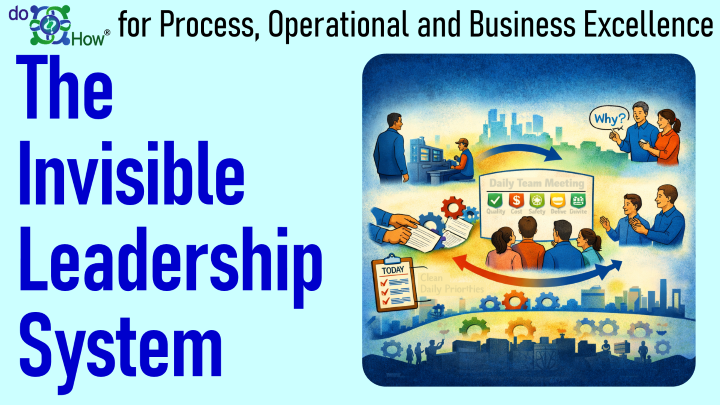
It was early morning when we arrived at the gates of a world-class factory, even before the day had begun. As we waited, the first employee to enter noticed us, paused, and gently asked who we were and why we were there. There was no hesitation—only a quiet sense of responsibility. On learning that we were facilitators, he guided the security to take care of us and ensured we were comfortably taken to the reception.
In that simple, unscripted moment, the true nature of the organisation revealed itself—not through systems or policies, but through behaviour.
That incident stayed with me. It reflected something deeper than courtesy—ownership, awareness, and alignment without instruction. It connected strongly with my earlier article, When KPIs Become Mirrors, Not Targets, where performance shifts when people stop chasing numbers and start understanding reality. Here, that awareness had already become behaviour—and behaviour had become culture.
In this article I explore that unseen layer—a system not written in manuals, but lived through daily actions, questions, and habits. It is this invisible system that quietly turns intention into consistency, and consistency into excellence.
In every world-class factory I have visited, there is something interesting.
You don’t first notice the machines.
You don’t first notice the technology.
You notice the way people behave every day.
- Leaders walk the shop floor for Genchi Gembutsu quietly.
- Problems are spoken about openly, instead of covering up.
- Teams look at updated boards with 1-3-10 Rule, not at laptops.
- Questions are asked calmly, with no one feeling insulted.
- Nobody is shouting. Nobody is hiding. Nobody is justifying.
At first it looks simple.
But after some time you realise something deeper:
This behaviour is not accidental. It is the result of an invisible system.
Not a system written in a thick manual.
A system that lives inside the daily habits of leaders.
This invisible system is like the subconscious mind of the company.
And when this subconscious works well, the factory improves almost naturally.
Leadership Is Not Sitting in the Office
In ordinary factories, leadership often means meetings, emails, and reports.
In world-class factories, leadership starts somewhere else.
At the workplace, at the Gemba.
Every day, leaders go to the shop floor.
Not for inspection. Not to find fault.
But to see and feel reality (Genchi Gembutsu) with their own senses.
They observe two things:
- Where something abnormal is appearing
- Where improvements are happening
Good leaders develop a habit of noticing problems when they are still small.
A small delay. A missing tool. A wrong number on a board.
These small signals are like early symptoms of illness.
If you notice early, the cure is easy. One thing you often hear in good factories is a simple question.
“Why?”
Not once. Often five times.
But the tone is important.
It is not: “Why did you make this mistake?”
Instead, it sounds more like: “Let us understand what really happened.”
When leaders ask questions without blame, something magical happens. People begin to speak honestly. And once the truth appears, the real cause of the problem becomes visible. Machines rarely cause big problems.
Systems do.
And systems can only improve when people feel safe to speak. A good team wants to perform well. But sometimes the system around them slows them down.
- Missing Materials.
- Incorrect CNC Programs.
- Missing Drawing Clarity.
- Missing Tools/Inserts.
- Waiting for Inspection.
- Incapable Processes.
- Delayed Approvals.
- Conflicting priorities.
- Unclear or No Targets.
In strong factories, leaders do not jump in immediately to fix everything. First, they check something important:
- Has the team done their part properly?
- Has the team reached out to the support functions for help immediately?
- Have the support functions responded swiftly with solutions?
If the answer is no, they coach, mentor and counsel.
If the answer is yes, then leadership steps in. Their job becomes simple:
Remove the obstacles that the system has created.
When obstacles disappear, the flow of work becomes smooth again.
Confusion is another biggest hidden enemies in any organisation. Different people running in different directions. Different interpretations of priorities.
Good factories avoid this through daily absolute clarity – Part#, Where, Quantity, Date
Leaders continuously reinforce:
- What is most important today
- What targets must be achieved
- What behaviour is expected from everyone
When this clarity repeats every day, it slowly becomes the culture of the organisation.
In strong companies, leaders do another thing very simple. They behave exactly the way they expect others to behave.
- They arrive prepared.
- They follow standards.
- They respect time.
- They treat people fairly.
This visible fairness builds something extremely valuable.
Trust.
Once trust grows, people stop working only because of rules. They begin working because they believe in the system—bringing it alive through everyday behaviour.
In world-class factories, this shows up in the daily pulse: a short, focused meeting around a visual board tracking Productivity, Quality, Cost, Delivery, Safety, and Morale. Results are visible, alignment is quick, and abnormalities trigger thoughtful questions.
Leaders prepare quietly—checking numbers, trends, and closures—and come with questions, not accusations, to deepen thinking.
Beyond daily rhythm, weekly reflection builds strength. Teams step back, study one key problem, and avoid quick fixes—because lasting excellence comes from patient, structured learning.
The System That Lives in Behaviour
When people visit world-class factories, they often ask:
- “What software are you using?”
- “What machine technology do you have?”
But the real strength is usually something else.
It is a system of leadership habits.
- Daily Genchi Gembutsu.
- Daily Standing Meeting.
- Weekly Sharpening.
- Calm questioning.
- Fair behaviour.
- Clear priorities.
- Continuous learning.
These habits slowly become invisible. They become part of the company’s subconscious. And once that happens, improvement no longer depends on heroic individuals. The system itself begins to win.
Sometimes when I walk through such factories, I feel something quietly reassuring.
Nothing dramatic is happening. But everything is moving in the right direction.
- Problems are visible.
- People are thinking.
- Leaders are present.
And that is when you realise something important. The strongest systems in the world are rarely loud. They work silently, every single day.
Happy reading!
Very well narrated,
Agree with points mentioned , again attitude building should happen downstream.
Many things can start happening from school like Japanese school does it.
Excellent read for a week to start. Thank you for the post. It clearly reminds some of the wrong steps we practice while on gemba tour. I will also share this with my colleagues, very apt hints for operation excellence with leadership commitment!
Simply wonderful
Nice. Daily leadership behaviour gets formed as culture of the company over the period
Thanks dear Dinakar for sharing it here. It is “Invaluable”. Regards.