
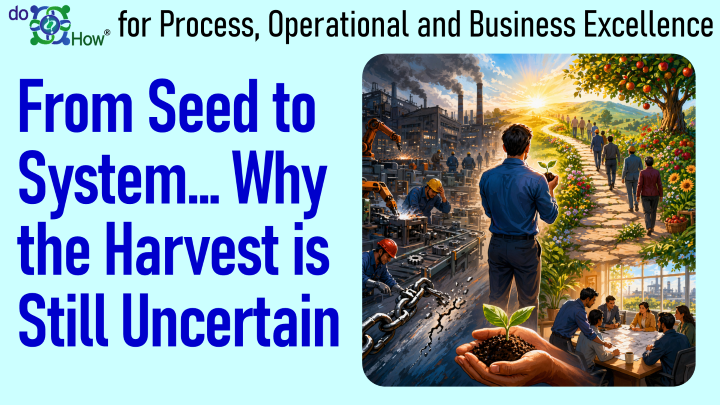
Last week, I wrote something that sounded very wise in my head: “First sow the seed… then expect the harvest.” Simple. Clean. Almost poetic.
This week, after walking through yet another shop floor, I found myself smiling—slightly embarrassed, if I’m honest. Because reality, as always, had a quiet way of reminding me that things are never as simple as they sound.
The truth is, in many organisations I work with, the seeds are already sown. Machines are running. People are working hard. Plans are made with sincerity. Effort is not the problem.
And yet… the harvest behaves like it has a mind of its own.
The performance floats somewhere between 73% and 98% of commitment—good enough to feel hopeful, but never good enough to feel confident. And I catch myself wondering:
Am I planting wisely… or just throwing seeds and giving motivational speeches?
This is not new for me. I have seen this pattern across industries, across teams, across levels of complexity. Different names, same story. Every time I walk in, I carry a quiet confidence: I know what needs to be done. And every time, within a few weeks, reality humbles me again. Because knowing is rarely the problem.
Doing it consistently… together… every single day—that’s where things start falling apart.
I usually begin with what I believe is a very practical structure. In my mind, it is so logical that I sometimes feel it should come with a “Why didn’t we think of this earlier?” label.
- Take care of today with zero defects.
- Ensure full traceability.
- Remove surprises for the coming weeks.
- Eliminate root causes and kill problems.
- Build the future on this robust foundation.
Neat. Logical. Almost elegant.
Because the moment I step onto the shop floor, my “beautiful structure” quietly steps aside… and reality takes over.
- A machine is waiting because inspection hasn’t happened.
- The first part is defective, since the fixture wasn’t validated before setup.
- An operator is juggling multiple machines like a circus act—without the applause.
- A repeat order, which everyone confidently called “easy,” turns into fresh trial and error because nobody captured the earlier learning.
And that’s when I remind myself—again and again:
We don’t repeat success. We repeat survival.
And survival, unfortunately, does not create stability.
Then comes another layer of the problem—one that is less visible, but far more damaging.
The visibility of order progress is either missing, inaccurate, or outdated, despite today’s technology. But what fascinates me (and occasionally frustrates me) is this:
The organisation continues as if everything is normal.
- No strong demand for real-time, accurate visibility.
- No urgency to build systems that reflect reality.
- No discomfort with operating in partial blindness.
- No reaction to “It’s not a technology problem, but data and discipline problem”
It’s almost like driving a vehicle with a fogged-up windshield… and saying, “We’ve managed so far, no?” And the day continues. Decisions are made. Reviews happen. Confidence is expressed. But without clarity, everyone is quietly hoping that somehow… things will sort themselves out.
Daily meetings are meant to fix this. Alignment. Coordination. Decision-making.
And to be fair, everyone shows up. Every function is present. On the surface, it looks complete. But over time, I realised something uncomfortable.
Many people are not there to decide.
They are there to report and pass the responsibility.
Problems are raised. Discussed. Acknowledged.
And then… carried forward.
Sometimes, I jokingly feel like I’m watching a long-running TV serial where every episode ends the same way: “To be continued…”
And then, of course, there’s me.
I walk in with intent, energy… and occasionally, more intensity than required (something I’m still learning to manage).
- I make the reality visible.
- I start connecting gaps.
- Linking them to customer impact.
- Questioning assumptions.
- Challenging comfort zones.
- Confronting shallow answers.
Some days, I walk out thinking, “That was useful.”
Other days, I go back and ask myself a slightly uncomfortable question: Did I help them see reality… or did I just make them uncomfortable? That question has stayed with me longer than I expected.
Because over time, one thing has become very clear to me.
These are not just process problems.
They are patterns.
Patterns of thinking. Patterns of reacting. Patterns of accepting.
People don’t act only based on what they know. They act based on what they have repeatedly experienced—and slowly accepted as “normal.”
- If delays are always manageable… they become acceptable.
- If trial and error is routine… it becomes expected.
- If commitments can slip without consequence… accountability fades quietly.
And when these patterns spread across teams, they stop being habits.
They become culture.
This is where I try to go beyond logic. I try to make reality felt. Not by exaggerating—but by connecting.
- A missed delivery is not just a number—it is a disappointed customer.
- A rejected part is not just scrap—it is wasted human effort.
- An idle machine is not just downtime—it is lost opportunity.
But even here, I have learned something the hard way. Emotion is powerful—but unpredictable.
Sometimes it creates reflection.
Sometimes it creates resistance.
Some people pause, think, and take ownership.
Others withdraw, justify, or silently disengage.
And that balance… is delicate.
The biggest paradox, however, sits with leadership.
Almost every leadership team agrees on one thing without hesitation:
“The shop floor should be at the centre.”
Some even say, “It should be at the top.” And I agree. But in practice, something shifts.
- Meetings take over.
- Escalations lose urgency as they move upward.
- Accountability becomes softer—not by intention, but by drift.
And slowly, without anyone planning it, the organisation becomes structured around discussions… instead of execution.
When I reflect on my own journey, I see this clearly.
I bring structure. I bring clarity. I bring urgency.
And I genuinely try to build trust, safety, and shared ownership.
And yet… results are not always proportional to effort.
That’s when another uncomfortable truth becomes visible.
People don’t resist change.
They resist feeling exposed.
And even well-intended efforts can sometimes feel that way.
So today, when I think about sowing seeds, I no longer see it as just about output. It is not enough to sow the seeds of products. We must also sow—consistently and consciously—the seeds of: Process, Visibility, Traceability, Discipline, Trust, and Respect.
Only then does the system take root.
- Not in documents.
- Not in presentations.
- But in daily behaviour.
And that leaves me with a question I am still working through and finding the doHow®:
If we truly want organisations where the shop floor drives decisions…Where reality is visible and accepted…Where commitments are honoured with discipline…Then how do we help leaders see the truth—Without making them feel that their authority or identity is under threat?
Because somewhere between truth and ego…there is a very thin line.
And how we walk that line may decide whether transformation actually happens—or quietly fades away.
Happy reading!
Dinakar essentially you have shared in detail from various angle what has been happening in many of plant operations across industries and organizations.
I will add couple of pointers:
1. Dier’s need (full involvement + commitment & ownership – practive mode!) must get reflected in everyone’s action.
2. Clear objectives are communicated, shared and necessary follow-up made for getting it into translation.
3. Learning from the past and failure does give clue, however, thinking with an open mind (cross-functions & cross-culture mind-set) for out-of the box adeas must be allowed to emerge and failure to be seen as constructive approach on how well to move on for achieving the bigger “picture”.
4. Two-way crisp communication, trust, good practices, continuous improvements, delivering both quality and VOW are necessary for organization-wide culture to be nourished from top-down trickle down to the bottom in every worker at palnt level.
Thanks Sunil, very rightly appended.