
In continuation to “From Habit to Culture… The Silent Agreements We Don’t Realize We’ve Signed”, this week I want to share my thoughts on this question that quietly troubles many of us.
We work hard. We stay busy. We attend meetings. We solve problems every day. And yet, somewhere deep inside, we feel a gap. The harvest doesn’t appear. Not sometimes—often not at all. There is no real improvement, no lasting result, no sense of progress some of us can truly feel. We just keep struggling to fulfil even the basics.
So, what is going wrong?
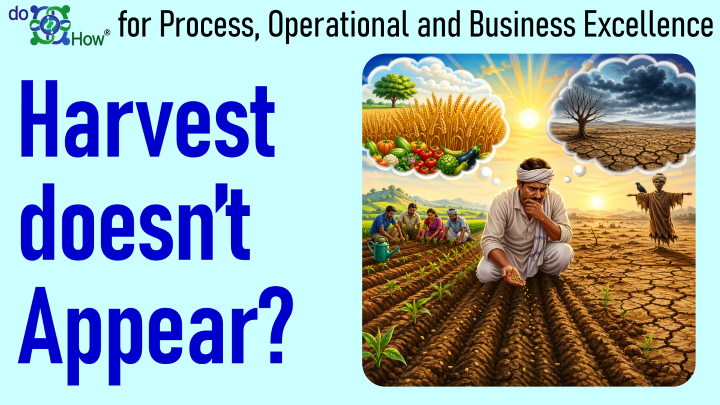
The Farmer Who Forgot the Basics
Imagine a farmer who wakes up early, goes to the field every day, and puts in sincere effort. He is not lazy. He is not careless. But he never truly prepares the soil, never clearly decides what crop to grow, never follows a proper method of planting, and rarely checks what is working or not.
Every day he is busy. But at the end of the season, there is no harvest.
Is the problem lack of effort? No.
The problem is simple: there was no clear way of working.
In Our Work Life, some of us, We Do the Same
In our factories, offices, and businesses, we behave like that farmer more often than we realize. We start work without clarity, do things in our own way, keep adjusting as we go, and rarely pause to reflect deeply. Work keeps moving, but direction keeps shifting.
And then we wonder why results don’t come.
The Missing Way: The doHow® Chakra Dialogue
Any meaningful result—whether in farming, manufacturing, or life—follows a simple rhythm. First, there is a Shared Blueprint, a clear understanding of what exactly we are trying to achieve. Then comes the Standard Playbook, where we agree on how exactly we will do it, the rules of the fame. This is followed by an Excellence Anchor, where we ensure the work is done properly and consistently. Finally, there is Continual Learning and Improvement, where we reflect and refine.
This is not theory. This is how nature works. This is how farming works. This is how success works.
But in our daily work, we skip steps. We jump into action before clarity. We adjust instead of agreeing. We finish work without learning. And slowly, the system weakens. Over the years, I have seen many types of people—not good or bad people, just different ways of thinking. Let me share these different ways or thinking, or mindsets, in our society and how each one reacts to the doHow® Chakra Dialogue.
The Different Mindsets We See Around Us
Some operate with a quiet “Chalta Hai” —Even if it’s not good enough, we’ll accept it) attitude. For them, everything is “good enough.” There is no strong need for clarity or standard. Work happens, but quality slowly fades, and the harvest becomes weak.
Some believe “thoda kiya, ho gaya” —Doing a Little is Good Enough. They begin with partial clarity, follow incomplete methods, and stop once something is achieved. It looks like progress, but it never becomes strong enough to sustain results.
Then there are the creative problem solvers with “jugaad” —Workaround or Frugal Mindset. They are sharp and resourceful, always finding quick solutions. But because there is no standard method, the same problem returns again and again. Success comes once, but it doesn’t stay.
There are also those who quietly step back from responsibility—the blame mindset. Work continues, but ownership is missing. Without ownership, no blueprint is truly shared, and no improvement is truly owned. In such a system, the harvest has no chance.
Some people are always doing. They move fast, act quickly, and stay busy. But they skip thinking. Without a clear blueprint or playbook, their effort becomes directionless. The harvest, if it comes, is random.
Others are always thinking. They have ideas, plans, and discussions. But action is weak, discipline is missing, and nothing really changes. In their case, the field is never even planted.
And then there are a few—very few—who operate differently. They seek clarity first, agree on a method, execute with discipline, and reflect regularly. They don’t make noise. But their results are steady and predictable. Their harvest appears, again and again.
The Truth We Must Accept
The harvest does not depend on how hard we work, how busy we are, or how intelligent we are. It depends on how consistently we follow the right way Shared Blueprint → Standard Playbook → Excellence Anchor → Continual Learning/Improvement of working.
Why We Don’t Follow This Way
Because, without realizing it, we have all signed silent agreements. We start without clarity. We adjust instead of aligning. We avoid standardization. We postpone improvement. These are not spoken decisions, but they slowly become our culture.
And over time, something even more dangerous happens—we stop expecting a real harvest.
Making It As Natural As Brushing Teeth
Think about brushing your teeth. You don’t debate it every day. You don’t postpone it. You don’t question its importance. You just do it, because it has become a habit.
Now imagine if our way of working became like that. Before starting any work, we naturally seek clarity. We agree on how to do it. We execute with discipline. And we reflect to improve. Not because someone is forcing us, but because it has become natural.
That is when the harvest will start appearing—not occasionally, but consistently.
The Shift We Need
We don’t need more training, more meetings, or more instructions. What we need is a simple but powerful shift—from just doing work to following a clear and shared way of working.
One Simple Question
Before starting any work, pause and ask: “Have we clearly agreed on why we need to do, what to do and how to do it?”
If the answer is no, don’t start. Because starting without clarity is the biggest reason the harvest never appears.
The field is not the problem. The effort is not the problem. Even the people are not the problem.
The problem is simple: we are working without a shared way of working.
The day we change that, the harvest will not just appear—it will become natural. Like breathing. Like brushing teeth. Like living.
And that is when real excellence begins.
Happy reading!