In my previous article, Constancy of Purpose: The Quiet Engine Behind Manufacturing Excellence, I wrote about the importance of staying focused on long-term goals despite being distracted by daily firefighting.
But purpose and envisioning alone is not enough. A destination without a daily discipline is merely a wish.
This week, I want to share the analysis I did during a mentoring session with a budding leader, on the correlations we discovered from our customers’ reports in the doHow® APP.
Over the past year, we have had the privilege of observing the Daily Work Management (DWM) practices of doHow® customer organisations. Day after day, week after week, they reported their observations, challenges, actions, and progress. What started as routine reporting gradually became a valuable source of evidence.
Recently, we analysed hundreds of these reports to answer a simple question:
What makes some Daily Work Management meetings short, focused, and productive, while others become long, exhausting discussions?
The answer was surprisingly clear.
The duration of the meeting was strongly linked to three simple practices that have been taught in manufacturing for decades:
- Rolling Plan
- Deviation Management
- Genchi Gembutsu and Genjitsu
In other words, the old wisdom still works.
And the data proved it.
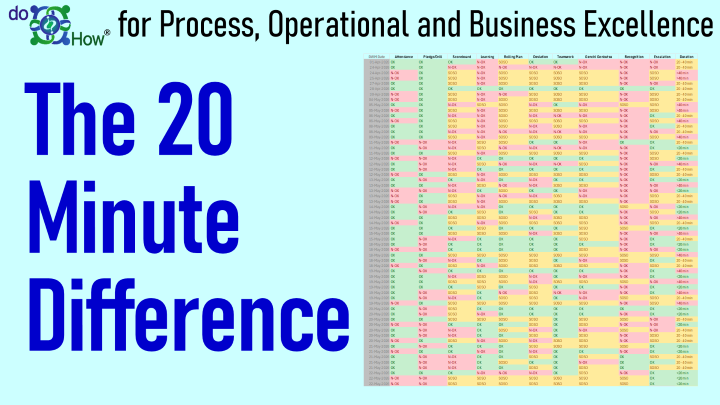
A Difference of More Than 20 Minutes
When teams consistently followed these practices well, their meetings were typically completed in less than twenty minutes.
When these practices were weak, meeting durations often not only stretched beyond forty minutes but with a lot of drama and discussion with little clear outcomes.
That is a difference of more than twenty minutes every day.
Twenty minutes may not sound like much.
But over a year, across supervisors, engineers, managers, and support functions, it becomes hundreds of hours of productive time recovered.
More importantly, it reflects something deeper.
Short meetings are usually not the result of rushing.
They are the result of clarity.
The Power of a Good Rolling Plan
Every successful journey starts with knowing where you are going.
A Rolling Plan is simply a shared view of the immediate future.
- What must be achieved today?
- What risks do we see?
- What support might be needed?
When teams arrived with a well-prepared Rolling Plan, discussions were focused.
People knew what was expected.
Priorities were already clear.
The meeting became a confirmation and alignment exercise.
But when the Rolling Plan was weak, the meeting often became a planning session itself.
- People debated priorities.
- Questions emerged.
- Clarifications multiplied.
- Time disappeared.
The data showed that teams with strong Rolling Plans consistently finished their meetings much faster than teams without them.
Perhaps this should not surprise us.
After all, when a family starts a long road trip without deciding the route, delays are inevitable. Why should factories be any different?
Deviation Management: Seeing Problems Early
One of the most common causes of firefighting is not the problem itself.
It is the delay in recognising the problem.
Deviation Management is simply the discipline of identifying gaps between expectation and reality, consciously and continuously.
- A missed target.
- A delayed delivery.
- A machine running slower than expected.
- A quality issue.
- A missing resource.
When deviations are identified early and visibly, discussions become straightforward.
Everyone already knows the issue. Attention shifts quickly toward action.
However, when deviations are hidden, ignored, or discovered only during the meeting, valuable time is lost.
The discussion shifts from solving to understanding.
People first need to establish what happened before deciding what to do.
The reporting data revealed a strong pattern.
Where deviation management was rated positively, meetings remained relatively short.
Where it was weak, meeting durations increased significantly.
The lesson is simple.
Problems do not become smaller when ignored.
They simply become more expensive.
Genchi Gembutsu and Genjitsu: Go, See and Check
Of all the findings, this one touched me the most.
The strongest relationship with shorter meetings came from Genchi Gembutsu and Genjitsu.
A Japanese term often translated as:
“Go, see and check for yourself.”
Many discussions become long because people are debating opinions.
- One person thinks the problem is material.
- Another believes it is the machine.
- Someone else blames planning.
- Everyone has a theory.
- Few have facts.
Genchi Gembutsu and Genjitsu changes everything.
Instead of discussing assumptions, people visit the workplace.
- They observe.
- They verify.
- They understand.
By the time the meeting starts, much of the confusion has already disappeared.
The data clearly showed that teams practising Genchi Gembutsu and Genjitsu consistently completed their meetings faster.
Not because they spoke less.
But because they knew more.
A ten-minute visit to the workplace often saves thirty minutes of discussion in a conference room.
An Interesting Discovery
Perhaps the most fascinating finding was not the correlation itself. It was how the correlation changed over time.
In the early months, meeting duration showed only a weak relationship with these practices.
Whether the ratings were good or poor, meeting durations were often similar. But as the months passed, something changed. The relationship became stronger and stronger. Eventually, the differences became dramatic.
Why?
Because people were learning.
Daily Work Management was no longer just a process being followed.
It was becoming a habit.
The teams were becoming better at recognising what good looked like.
Their assessments became more accurate.
Their behaviours became more consistent.
Their understanding matured.
This is exactly how improvement should look.
Not as a sudden breakthrough.
But as a gradual strengthening of capability.
Daily Work Management Is Not About Meetings
Many organisations mistakenly believe Daily Work Management is about conducting meetings.
It is not. The meeting is only the visible part. The real work happens before the meeting.
- The Rolling Plan is prepared.
- Deviations are identified.
- Facts are gathered.
- The workplace is observed.
- Actions are updated.
The meeting merely connects these activities together. When these disciplines are strong, meetings become short. When these disciplines are weak, meetings become long.
The duration is not the cause. It is the symptom.
The Quiet Proof of Excellence
Manufacturing excellence rarely arrives with dramatic announcements. It grows quietly.
- A better plan.
- A clearer deviation.
- A visit to the workplace.
- A faster decision.
- A shorter meeting.
- A more predictable day.
- Then another day.
- And another.
Over time, these seemingly small habits compound into extraordinary results.
The evidence from more than a year of reporting across various doHow® customer organisations reinforces a truth that many great manufacturing leaders have understood for decades:
Predictable performance is not created by heroic effort. It is created by disciplined daily habits.
Constancy of purpose gives people a destination.
Daily Work Management gives them a path.
And every day that they faithfully follow that path, they move one step further away from firefighting and one step closer to excellence.
Happy reading!