
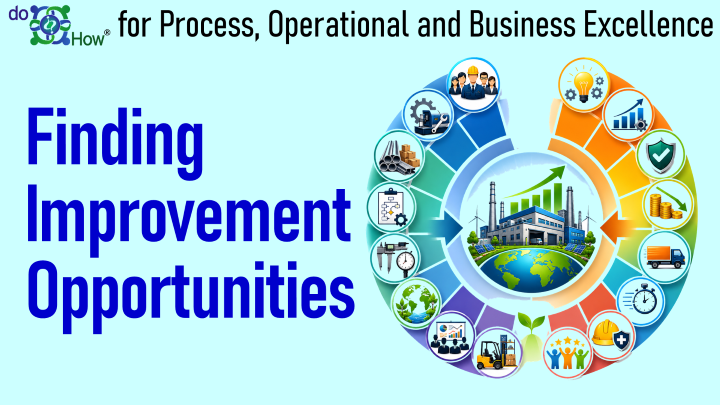
Last week my article ‘The 20-Minute Difference: What More Than a Year of DWM Taught Us’ was about the Daily Work Management. During the DWM Genchi Gembutsu and Genjitsu (Go and see and fetch the data and facts yourself) is also a standard Agenda Point. This week my article is about one of its key outcomes – recognising and fetching the improvement opportunities.
For many years, whenever I walked into a factory, I carried a A6 notepad initially, then Palm PDA, and finally a Smartphone, for taking notes. I was trained to look for problems from my early days by my mentors. Machine breakdowns. Quality defects. Inventory piles. Missed deliveries. Safety concerns.
But over time, I discovered something interesting. The biggest opportunities were rarely hidden. In fact, they were usually staring everyone in the face. The problem was not that people couldn’t see them. The problem was that people had stopped noticing them.
- The operator walked around the leaking machine every day.
- The supervisor had become accustomed to late material.
- The planner had accepted schedule changes as normal.
- The quality engineer expected rework.
- The maintenance technician expected breakdowns.
- The buyer expected shortages.
- The leadership team expected firefighting.
What was abnormal had slowly become normal. That is why Gemba is so powerful. Gemba is not merely going to the workplace. Gemba is learning to see again.
Every Process Is Continuously Talking to Us
When I visit a workplace, I often tell people: “The process is continuously speaking to us. The question is whether we are listening.”
- Every delay is speaking.
- Every queue is speaking.
- Every frustrated employee is speaking.
- Every workaround is speaking.
- Every safety risk is speaking.
- Every customer complaint is speaking.
- Every pile of inventory is speaking.
- Every breakdown is speaking.
The process is constantly revealing improvement opportunities. The challenge is knowing where to look. Over the years, I found it useful to view every operation from two perspectives:
The Supply Side – 8M
The resources creating value: Man / Mindset, Machine / Maintenance. Material, Method, Measurement, Milieu / Mother Earth, Management, and Material Handling.
The Demand Side – IPQCDRSM
The outcomes we want: Improvements/Innovation, Productivity, Quality, Cost, Delivery, Response, Safety, and Morale, which drive Sustainable Profitable Growth.
Every improvement opportunity is usually hiding somewhere in the 8Ms and affecting one or more PQCDSMIG outcomes. Once you understand this relationship, improvement opportunities become much easier to spot and prioritise the problem solving and improvement.
What Should We Look For?
The next time you go to Gemba, don’t start by asking: “What is the problem?”
Instead ask: “What is preventing this system from creating more value?“
That simple shift changes everything.
MAN / MINDSET
Look at people first. Not because people are the problem. Because people often reveal where the problems are. Ask yourself:
- Are people waiting?
- Are people searching?
- Are people frustrated?
- Are people stressed?
- Are people repeatedly firefighting?
- Are people solving problems or only reacting to them?
- Are people afraid to raise concerns?
- Are people improving the process?
These observations directly impact:
- Improvement/Innovation
- Productivity
- Quality
- Delivery
- Response
- Safety
- Morale
A tired and frustrated workforce is often the first visible symptom of an unhealthy system.
MACHINE / MAINTENANCE
Machines tell stories. Listen carefully. Ask: “Is the machine predictable?” Look for:
- Breakdowns
- Minor stoppages
- Long setups
- Frequent adjustments
- Excessive vibration
- Oil leaks
- Temporary repairs
- Operators compensating for machine weaknesses
Unpredictable machines create:
- Productivity losses
- Quality variation
- Delivery instability
- Cost escalation
- Morale reduction
The best factories do not merely repair machines. They make machine behaviour predictable.
MATERIAL
Material often reveals hidden waste. Ask: “Why is this inventory here?” Look for:
- Excess inventory
- Shortages
- Obsolete stock
- Wrong material
- Damaged material
- Multiple storage locations
- Expediting activity
Material issues affect:
- Productivity
- Quality
- Cost
- Delivery
METHOD
Method is where many hidden opportunities live. Observe carefully. Ask: “Why is this step necessary?” Look for:
- Different operators using different methods
- Rework loops
- Excess approvals
- Duplicate activities
- Workarounds
- Excessive paperwork
- Complex procedures
Method improvements often create dramatic gains across:
- Productivity
- Quality
- Cost
- Delivery
MEASUREMENT
What gets measured gets managed. But many organisations measure activities rather than outcomes. Ask: “Can we trust this data?” Look for:
- Manual data collection
- Reports nobody uses
- Conflicting numbers
- Delayed information
- Excessive reporting effort
- Poor measurement capability
- Poor process capability
Measurement directly influences:
- Quality
- Cost
- Delivery
MILIEU / MOTHER EARTH
The environment influences behaviour more than most people realise. Ask: “Does this environment help people succeed?” Look for:
- Noise
- Heat
- Dust
- Poor lighting
- Congestion
- Poor ergonomics
- Excess waste generation
- Energy losses
- Water losses
- Environmental risks
A healthy environment improves:
- Safety
- Morale
- Productivity
- Sustainability
MANAGEMENT
Management systems leave fingerprints everywhere. Ask: “Is management helping flow or disrupting flow?” Look for:
- Unclear priorities
- Conflicting instructions
- Delayed decisions
- Lack of accountability
- Excess meetings
- Constant urgency
- Firefighting culture
- Problems repeatedly recurring
Management impacts every IPQCDRSM outcomes.
MATERIAL HANDLING
Many factories underestimate material handling. Ask: “Why is this material moving at all?” Yet some of the biggest opportunities hide here. Look for:
- Excess movement
- Long transport routes
- Waiting for forklifts
- Double handling
- Congestion
- Unsafe transport
- Unclear material locations
Every unnecessary movement consumes time, money, energy, and attention.
The Engineering Lens
For manufacturing organisations, there is another powerful layer.
Ask:
- Why is this variation occurring?
- Why is this process not repeatable?
- Why is this dependent on operator skill?
- Why does this require adjustment?
- Why is this not predictable?
Observe:
- Robust clamping
- Repeatable references
- Process capability
- Measurement capability
- Tool life variation
- Cycle time variation
- Setup losses
- Motion waste
- Tool changes
- Process parameter optimisation
- Error-proofing effectiveness
The Most Powerful Question
After thousands of Gemba visits, I have found one question more useful than any other.
Not: “What went wrong?”
Not: “Who caused this?”
But: “What is this process trying to tell us?”
When we ask this question sincerely, the workplace begins teaching us. Improvement opportunities stop being hidden. They become obvious.
The next time you go to Gemba, don’t go looking for problems. Go looking for opportunities to create more prosperity. Look through the lens of the 8Ms. Observe the impact on IPQCDRSM. Listen carefully. The process is already telling you exactly what needs to be improved.
You simply need to learn how to see it.
Happy reading!
Good write up sir
This is very elaborate and well explained Sir.
Thanks for sharing the same.
Very true. There are so many opportunities for improvement around us, we barely tend to notice them. To notice them, we need fresh set of eyes every time. Once we have that mindset / expertise, it becomes so obvious and easy
Excellent article Dinakar. A wonderful check list for the shop floor personnel to follow and attempt to root out the issues cropping up on daily basis. If someone practices using this check list, over a period of time he would not need the check list and it would be automatically processed in his mind.
Hello Dinakar, Good article. focus should be on human physical and mind too and exercises for 15 minutes to be made mandatory as people spend more time in travel. also after lunch 10 minutes power nap set up to be done. the cooler the mind, more effective the work.
Absolutely agree. Thanks Karthik