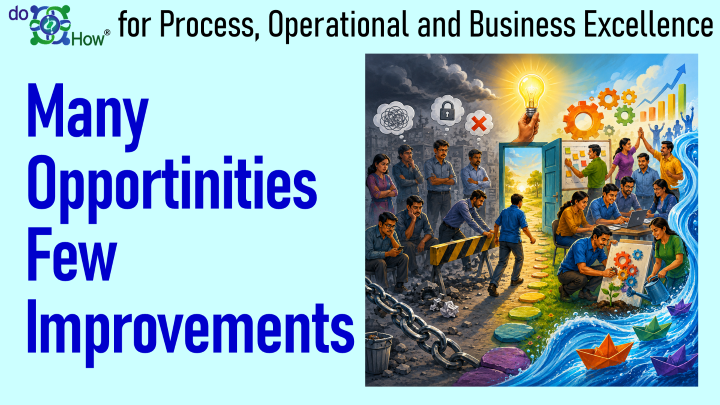
Last week, in my article “Finding Improvement Opportunities During a Gemba Visit,” I wrote about something I have experienced repeatedly over the years. The biggest improvement opportunities are rarely hidden. Most of them are right in front of us. We walk past them every day. We see them. We experience them. We even complain about them.
Yet very few of them ever get fixed.
Over the years, I have often wondered:
If people can see the opportunity, why don’t they act on it?
Why do people listen to good ideas but never implement them? Why do people themselves come up with improvement ideas but never execute them? Why do organizations spend hours discussing problems but continue to operate exactly the same way?
These questions have intrigued me for decades.
Before I share my thoughts, I would like to introduce a small resource I recently created.
A Small Trigger for Bigger Thinking
Many readers of my previous article asked me how they could improve their ability to identify opportunities during a Gemba visit. To help with that, I have created a playlist of short videos called “Spotting Improvement Opportunities.“
The purpose of these videos is not to teach solutions. The purpose is to trigger thinking. Sometimes all we need is a different way of looking at the same situation.
The videos contain simple observation hints from manufacturing environments that can help leaders, supervisors, engineers, operators, entrepreneurs, and even students train their eyes to see opportunities that are normally ignored.
Because improvement does not begin with action. Improvement begins with awareness. And awareness begins with seeing. But seeing alone is not enough.
The Strange Human Habit of Preserving the Status Quo
Throughout my career, I have met thousands of people.
Operators. Supervisors. Managers. Business owners. Directors. Consultants.
And one thing has remained remarkably consistent. Almost all of them want improvement. Very few people want change.
At first glance this sounds contradictory. But it is true. Everyone wants better results. Nobody wants the discomfort that often accompanies getting those better results.
Human beings are naturally designed to conserve energy and avoid risk. If the current situation is tolerable, the mind quietly whispers:
“Why disturb what is already working?”
- The machine may be inefficient.
- The process may be slow.
- The meetings may be ineffective.
- The reports may be useless.
- The inventory may be excessive.
But if the business is somehow surviving, people unconsciously choose familiarity over uncertainty. The known pain feels safer than the unknown future.
Why Good Ideas Die So Quickly
Over the years I have observed that improvement ideas usually die for one of these seven reasons.
- Fear of Failure
“What if it doesn’t work?” This single question has killed more improvement ideas than technical difficulties ever have.
- People worry about criticism.
- They worry about embarrassment.
- They worry about being blamed.
So they decide it is safer not to try.
- Fear of Extra Work
Improvement requires effort before it creates benefit. Unfortunately, many people only see the effort. They do not yet see the benefit. Therefore, improvement appears as an additional burden.
- Lack of Ownership
Many people identify problems. Few people adopt them. There is a big difference. The moment a person says: “This is my problem to solve”, everything changes.
- Lack of Belief
People often underestimate their own ability. They assume someone smarter, richer, more experienced, or more senior should solve it. As a result, opportunities remain untouched.
- Comfort with Existing Habits
Habits slowly become culture. Culture slowly becomes identity. And once something becomes part of our identity, changing it becomes emotionally difficult.
- No Immediate Reward
The human brain loves instant gratification. Improvement often rewards patience. The gap between effort and reward discourages many people.
- Learned Helplessness
Perhaps the most dangerous reason of all. People have suggested improvements before. Nothing happened. They raised concerns before. Nothing changed. Eventually they stop trying. Not because they don’t care. Because they no longer believe anything will change.
Some recap from my earlier articles
A few months ago, in my article “Why Some People Just Nod But Don’t Really Mean It,” I wrote about a behaviour that exists in almost every organization.
People nod. People agree. People say “Good idea.” People promise support. But nothing happens afterwards.
The reason is simple. Agreement is intellectual. Commitment is emotional.
People may agree with your idea. But unless they emotionally connect with the reason behind it, they rarely act. This is why presentations alone seldom create transformation. People change when they feel. Not when they merely hear.
In another article, “Why Simple Things Become So Hard in Business,” I reflected on something that repeatedly surprises leaders.
Most business problems are not complicated.
- The solutions are often simple.
- The challenge lies in consistent execution.
- The problem is rarely knowledge.
- The problem is behaviour.
- The problem is discipline.
- The problem is follow-through.
The problem is sustaining the change long enough for it to become a habit.
Many organizations do not fail because they lack intelligence. They fail because they cannot consistently execute simple improvements.
Over the years I have become convinced that improvement does not happen automatically. It requires catalysation or some nudge.
Just like certain chemical reactions need a catalyst, human transformation often needs one too. This is something I explored in my article “The doHow® of Changing Mindset & Culture.”
People rarely change because they are instructed. People change because they are inspired, persuaded, guided, challenged, supported, encouraged, coached, and sometimes emotionally awakened.
That is the essence of catalysation.
Internal Catalysts
Every organization needs internal catalysts.
These are individuals who keep improvement alive.
- They may be leaders.
- They may be supervisors.
- They may be staff.
- They may be operators.
- They may even be interns.
Their designation is not important. Their behaviour is.
- They ask questions.
- They challenge assumptions.
- They encourage experimentation.
- They celebrate small wins.
- They persist when others give up.
- Most importantly, they create hope.
A single committed internal catalyst can influence hundreds of people.
External Catalysts
Sometimes organizations become prisoners of their own assumptions. Everyone becomes accustomed to existing practices. Blind spots become invisible. This is where external catalysts become valuable.
- A mentor.
- A coach.
- A consultant.
- A customer.
- A supplier.
- An industry expert.
- An external catalyst brings fresh eyes.
- Fresh questions.
- Fresh perspectives.
They often help people see what has been visible all along. Not because they are smarter. Because they are not trapped by the same assumptions.
How to Unleash a Continual Improvement Wave
If you genuinely want to create a culture of continual improvement, start small.
Very small.
- Teach people how to observe.
- Encourage questions.
- Reward curiosity.
- Make problems visible.
- Celebrate small improvements.
- Remove the fear of failure.
- Create regular forums for idea sharing.
- Follow up relentlessly.
- Develop internal catalysts.
- Consistently engage external catalysts.
Remember:
People do not resist improvement. People resist uncertainty. The moment they experience success, even a small success, resistance starts melting. Success creates belief. Belief creates momentum. Momentum creates culture. Culture creates excellence.
After more than four decades of visiting factories, offices, construction sites, boardrooms, and shop floors, I have come to a simple conclusion.
The world is not short of ideas. Organizations are not short of opportunities. People are not short of intelligence. What is often missing is the courage to take the first step.
The opportunity is already there. The idea is already there. The capability is already there. Perhaps what is needed is a catalyst. Someone to ask the question. Someone to provide a hint. Someone to ignite the spark. Because once people begin experiencing the joy of improvement, something remarkable happens.
Improvement stops becoming an initiative. It becomes a habit.
And when enough people develop that habit, a continual improvement wave begins to spread across the entire organization.
- One small idea.
- One small experiment.
- One small success at a time.
Happy reading!