Last week, in my article “Plan B: The Courage to See Opportunities Again,” I wrote about finding ways to achieve our planned outcomes despite unexpected challenges. This week, I want to share another lesson that I have learnt over many years—one that quietly decides whether an organisation consistently delivers stable PQCDSM performance, profitable growth, effective leaders, efficient managers, sustainable execution, and delighted customers and stakeholders.
That lesson is personal accountability.
Every organisation dreams of people who are proactive, take ownership, solve problems before they grow, care about quality, support one another, and deliver what they promise. To make this happen, organisations introduce vision, mission, values, policies, targets, reviews, dashboards, and performance systems. These are all necessary. But I have learnt that they are only like the parts of a car. Unless someone is willing to hold the steering wheel with care and responsibility, the journey will never reach its destination.
This made me ask myself a simple question.
Where does personal accountability really begin?
Over the years, my answer has become very clear.
It begins when a leader or manager truly knows the people he or she leads or manages.
Recently, while helping one of our customers understand why employee retention had reduced slightly, our discussions led us to an interesting insight. The problem was not salaries. It was not the work itself. It was not even the organisation.
Many junior and middle managers simply did not know their team members well enough. That may sound like a small gap, but its consequences are enormous.
When a leader or manager knows a team member almost like an open book, small changes never go unnoticed. A drop in enthusiasm, a little frustration, a change in behaviour, or the first signs of disengagement become visible long before the employee consciously decides to leave. That gives the leader or manager enough time to understand, support, encourage, and sometimes pleasantly surprise the employee with genuine care before the relationship begins to weaken.
Looking back at my own career, I remember periods when attrition in my teams reduced significantly. It certainly was not because I had extraordinary budgets or attractive rewards.
If I have to identify one reason, it would simply be this.
I genuinely wanted every member of my team to become better than me. I was and even today am authentically candid, gave and give frank feedback whenever needed, appreciated and appreciate people whenever they deserved it, and took and take a genuine interest in helping each person grow—not just because it benefited the organisation, but because I sincerely wanted and want them to succeed in life and ultimately surpass me.
When I reflect on where this instinct came from, my mind goes back to my early years as a team leader in Brazil. During a management development programme, one of the trainers made a statement that has remained deeply etched in my memory ever since.
“From an employee’s perspective, there is no company, no board, no management, no policy, and no guideline. The employee simply believes they are working for you.”
Those simple words completely transformed my understanding of leadership and management. I realised that, in the eyes of every team member, a leader or manager is not merely a representative of the organisation—the leader or manager is the organisation. The organisation’s values, policies, culture, fairness, and care are all experienced through the leader’s or manager’s words, decisions, and actions. That realisation has shaped the way I have led people throughout my career, and the way I mentor leaders, managers and organisations.
Think about it for a moment.
Just as we judge a restaurant by the way the waiter serves us, employees understand an organisation through the way their immediate leader or manager treats them.
To them, the leader or manager is the living reflection of the organisation’s values, policies, culture, promises, and intentions.
- If the leader or manager listens, the organisation listens.
- If the leader or manager cares, the organisation cares.
- If the leader or manager is fair, the organisation is fair.
- If the leader or manager inspires, the organisation inspires.
- If the leader or manager ignores people, the organisation appears indifferent.
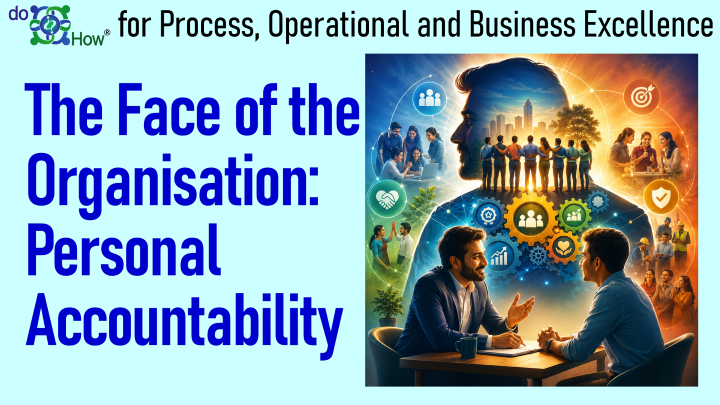
Whether we realise it or not, every leader or manager becomes the face, the voice, and the heart of the organisation for the people they lead.
That is perhaps why this age-old adage continues to be true.
People rarely leave organisations. More often, they leave the experience they have with their immediate leader or manager.
The encouraging part is that this experience can be transformed.
This is exactly where the doHow® approach has been making a remarkable difference in the people lead and manage. Instead of expecting accountability first, doHow® teaches and drives leaders or managers to build understanding first.
Instead of assuming what people need, it encourages leaders or managers to discover it. Instead of depending only on annual appraisals, it promotes regular, meaningful one-on-one dialogues where the purpose is not evaluation but understanding.
These conversations gradually help a leader or manager understand the person behind the employee.
- What does this person believe their role is really about?
- What gives them energy, and what drains it?
- What dreams are they working towards?
- What values will they never compromise?
- How do they prefer to communicate?
- How do they make decisions?
- Do they enjoy structure or flexibility?
- What situations create stress or frustration?
- How do they like to be appreciated?
- What personal responsibilities outside work influence their daily life?
The answers to these questions become like pieces of a puzzle.
Individually they may appear small.
Together, they reveal the complete picture of the human being standing in front of us.
Once that picture becomes clear, leadership or management naturally changes.
- The same message is communicated differently.
- The same target is explained differently.
- The same feedback is delivered differently.
- The same appreciation becomes more meaningful.
- The same challenge receives better support.
People begin to feel understood instead of feeling being managed.
Trusted instead of monitored. Inspired instead of instructed.
That is when something beautiful happens.
Personal accountability no longer needs to be demanded. It begins to grow naturally.
People willingly take ownership because they know their leader or manager genuinely understands them, believes in them, and wants them to succeed.
As accountability grows, teamwork becomes stronger. Problems are raised earlier instead of being hidden. Learning becomes faster. Execution becomes more disciplined. Delivery becomes more predictable. Customers become happier. Attrition reduces. Leadership or management becomes stronger. Sustainable business excellence slowly becomes a habit rather than an occasional achievement.
In the end, I have come to believe that organisations do not become great because they have the best vision, mission, values, policies, guidelines. They become great because every leader or manager becomes the finest living example of those frameworks.
When leaders or managers know their people deeply, people willingly own the organisation’s purpose. And when people own the purpose, extraordinary business results become the natural outcome.
That is personal accountability.
What insight did you get from this article to improve the personal accountability of all your team members?
Happy reading!