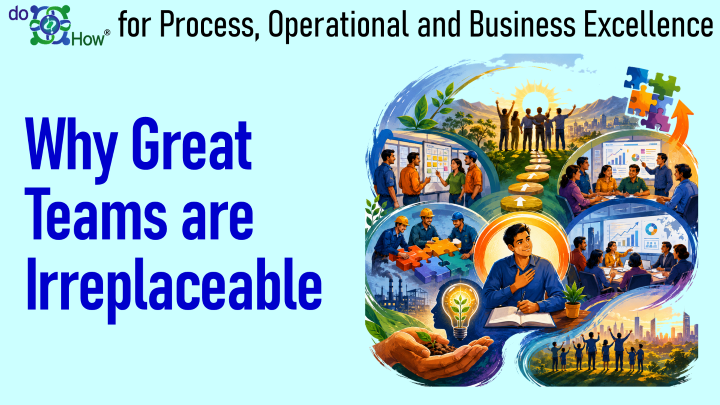
Last week, I wrote the article “The Face of the Organisation: Personal Accountability Begins with Knowing Your People“, with the central message – Organisations do not serve customers. People do. Every customer remembers a person before they remember a company.
This week, I want to take that thought one step further.
Knowing your people is only the beginning.
The real question is:
How does an ordinary individual evolve into a dependable professional, a trusted teammate, a key contributor to a high-performing team, and ultimately an irreplaceable asset who consistently delivers exceptional outcomes?
After spending more than three decades working with organisations of every size, from shop floors to boardrooms, I have realised that prosperity rarely depends on intelligence alone.
Most organisations are not short of capable people. They are short of people who consistently practise the behaviours that create trust.
Because accountability is not created by policies. It is created by habits. And habits are built every single day.
Personal mastery always comes before team mastery
Many organisations try to improve teamwork first.
They organise workshops.
They install dashboards.
They create KPIs.
They buy new software.
Yet very little changes.
Why?
Because teams cannot rise above the habits of the individuals within them.
- A team cannot become disciplined if its members are not disciplined.
- A team cannot communicate openly if individuals are afraid to speak honestly.
- A team cannot continually improve if every person believes improvement is someone else’s responsibility.
That is why the journey always begins with the individual. Before people learn to work better together, they must first learn to work better with themselves.
That belief became the foundation of the doHow® Developer.
Rather than asking people to attend another training programme and forget it a week later, the doHow® Developer follows a much simpler rhythm:
- Learn one idea all by yourself.
- Check whether you understood it.
- Submit doHow® Enabler every day for 21 days.
Slowly, knowledge becomes behaviour. Behaviour becomes habit. Habit becomes character. And character becomes accountability.
- It is preparing before someone asks.
- It is admitting mistakes before someone discovers them.
- It is solving problems instead of explaining why they happened.
- It is keeping promises made to others—and to yourself.
No manager can create this. No HR policy can enforce this. No training can enable this. Only daily self-reflection can build it.
I am sure each one of us know that success needs something more. Teamwork. The purpose of teamwork is not merely to work together.
It is to think together.
Every organisation today has meetings. Yet surprisingly few organisations truly learn from them.
- Many daily meetings become reporting sessions.
- Weekly meetings become blame sessions.
- Monthly reviews become presentations.
People assume the are attending because they have to—not because they learn something valuable, for creating value.
Over many years, I have found that high-performing organisations share three simple management rhythms.
Each one answers a different question.
Every day we ask: What did we learn yesterday and are we prepared to succeed today?
That is the purpose of doHow® Daily Work Management (DWM).
Every week we ask: Which is the top challenge and how shall we learn and improve?
That is the purpose of the doHow® Weekly Sharpening Workshop (WSW).
Every month we ask: Are we consistently performing and moving towards the future we want to build?
That is the purpose of the doHow® Monthly Business Review (MBR).
Prosperity is created when all these learning journeys happen together. This is perhaps the most important lesson I have learned and validated.
Personal mastery without teamwork creates brilliant individuals who struggle to work with others. Teamwork without personal mastery creates meetings full of people waiting for someone else to take responsibility.
The doHow® Developer develops the person.
Regular reflection reports submitted through the doHow® Enabler by approximately 100 executives from our customer organisations over the past two years demonstrate rapid and visible development of the competencies most critical for sustained success.
Based on the homework reflections submitted by participants across multiple organisations, there is clear evidence of progression from individual awareness to disciplined execution. The reports increasingly demonstrate stronger time planning, systems thinking, critical thinking, flawless execution, self-awareness, teamwork, process discipline, customer focus and continual improvement, indicating that learners are progressively internalising doHow® Readiness Competencies to solve real workplace challenges and create sustainable value.
The doHow® DWM develops daily execution, through collective thinking.
The improvement data captured by doHow® from the 25 regular Daily Work Management (DWM) over the past 18 months, across multiple customer organisations now delivering consistent performance, reveals this interesting insight.
Longer improvement cycles for Rolling Plan and Deviation Management indicate reluctance to expose problems, weak anticipation, limited cross-functional ownership, and planning treated as documentation rather than a proactive decision-making process.
The doHow® WSW develops organisational learning, through collective thinking.
doHow® insights from the Weekly Sharpening Workshop (WSW) with our continually growing customers over the past 18 months provide strong evidence supporting an already established hypothesis.
Short duration after implementation for just ticking the meeting participation contrasted with prolonged duration for problem solving and continual learning, demonstrates that predictable organisational performance ultimately depends on analytical capability, accountability, ownership, learning culture and disciplined execution rather than compliance alone.
The doHow® MBR develops collective strategic thinking.
Analysis of doHow® data collected over the past two years from the Management Business Review (MBR) of our sustainably growing clients provides further evidence supporting the well-established hypothesis about the weakest organisational practices in struggling organisations.
The longest duration after implementation for effective functional team presentations, culture measurement, stakeholder management and systemic audits reveal that predictable business performance depends on cross-functional ownership, systems thinking, fact-based decisions, organisational learning and continual cultural evolution.
Together, they transform isolated effort into collective capability. They create a rhythm where people learn every day, teams improve every week, and leaders strengthen direction every month. Over time, accountability becomes part of the organisation’s culture rather than something imposed through supervision.
How are you making your ordinary people consistently deliver exceptional outcomes?
Sign-up and check out the doHow®: https://dohow.samuthana.com
Happy reading!