Last week in the article B02. Identity, Beliefs and Values: The Invisible Foundation of Lasting Prosperity, I explored how our identity silently shapes our beliefs, our beliefs influence our decisions, and our decisions ultimately determine our results. While skills can be learnt and knowledge can be acquired, it is our identity that quietly determines how we think, what we value, and ultimately the kind of organisation we build.
This week, I would like to take that conversation one step further. What happens when your role is no longer to lead individuals, but to lead leaders? What identity must you embrace when your responsibility extends far beyond your own actions and success depends on the capability of hundreds or even thousands of people working together to consistently deliver today’s commitments while continually creating greater value for tomorrow?
Over the years, I have observed that almost every experienced leader genuinely believes they are accountable. Yet, when I listen carefully, I notice that accountability means different things to different leaders.
Some believe they exist to uphold uncompromising standards. Others see themselves as developers of people. Some define success through results, while others through purpose, innovation, systems, risk management, ownership, or harmony.
None of these beliefs are wrong. In fact, every one of them represents an important dimension of effective leadership. The challenge begins when we mistake one dimension for the whole.
- The leader who identifies only with standards may unintentionally create fear instead of ownership.
- The leader who identifies only with caring may hesitate to challenge mediocrity.
- The leader driven only by results may overlook the capability required to sustain those results.
- The visionary may inspire without ensuring disciplined execution.
- The strategist may build elegant systems that people never truly embrace.
- The protector may minimise risk while unintentionally slowing progress.
- The owner may unknowingly centralise responsibility.
- The harmoniser may preserve relationships while avoiding conversations that strengthen performance.
These are not personality flaws. They are simply the natural consequences of the identities we choose to live by. As my own understanding has evolved, I have come to believe that before leaders of leaders embrace any leadership philosophy, they must first embrace one fundamental identity.
I exist to enable those who create value.
Every level of leadership exists for one purpose—to remove barriers, provide clarity, build capability, and create the conditions for those closest to the customer and the value stream to effortlessly create value to the stakeholders, customers mainly.
- Instead of expecting the shop floor to come to the top floor, leadership goes to the Gemba.
- Instead of managing from reports, leaders personally observe reality.
- Instead of demanding explanations after problems occur, they proactively understand the conditions that created them.
I have witnessed remarkable transformations when leadership teams simply dedicated a short period every day to collectively observe the workplace, understand reality and ask one simple question:
“What is preventing our people from succeeding today?”
That seemingly small shift changes priorities, conversations, routines and eventually culture itself. Once this identity is established, another realisation naturally follows. Organisations do not become world class because individuals become extraordinary. They become world class because teams become mutual value creators.
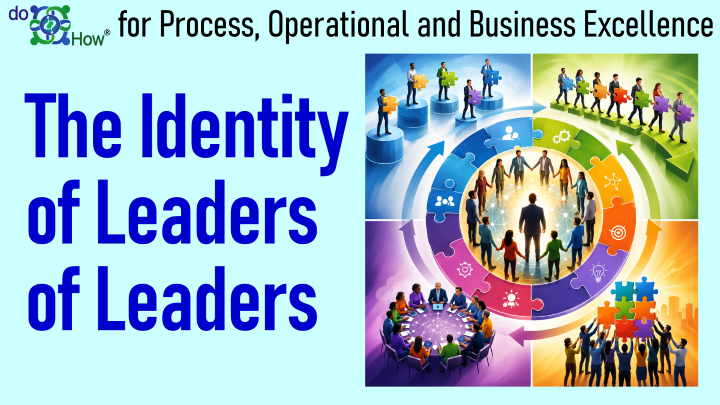
In an earlier article The Teamwork Unleashed, I shared four progressively mature forms of teamwork.
The first is Pooled Interdependence, where individuals contribute independently towards a common goal. Like cashiers in a supermarket or players in a golf tournament, each person performs well within their own boundaries, and the final outcome is simply the sum of individual contributions.
The second is Sequential Interdependence, where one person’s output becomes another’s input. Like a relay race or a manufacturing process, success depends not only on individual performance but also on smooth handovers and disciplined execution.
The third is Reciprocal Interdependence, where people continuously exchange information, support and feedback. Cross-functional project teams and successful sports teams thrive because they constantly adapt to one another rather than merely completing their own tasks.
The highest level is Comprehensive Interdependence. Here, every individual understands the overall mission, remains aware of the real-time progress of the entire system, and instinctively decides when to contribute independently, sequentially or collaboratively for the success of the whole. Boundaries become invisible. Information flows freely. Transparency replaces assumptions. Conversations replace silos. Collective ownership replaces functional optimisation. The organisation begins behaving like a single living organism instead of disconnected departments.
In my experience, this is one of the clearest differences between struggling organisations and world-class organisations. Struggling organisations primarily operate through pooled or sequential interdependence. World-class organisations cultivate comprehensive interdependence until it becomes their natural way of working.
People no longer ask,
“Is this my responsibility?”
Instead, they ask,
“What does the organisation need from me right now?”
This, I believe, is the true responsibility of leaders of leaders.
Not supervising more people. Not making more decisions. Not solving more problems. But creating an environment where Comprehensive Interdependence naturally emerges.
That begins with a simple but profound question.
What kind of leader am I?
- Am I someone who directs work?
- Or someone who enables people?
- Do I measure my value by the decisions I make?
- Or by the capability I help others develop?
- Do I create dependence on myself?
- Or confidence in others?
Every leader naturally leans towards one style.
The mature leader gradually expands beyond personality preferences until they can respond according to what the organisation needs rather than what comes most naturally.
The second question is even more revealing.
What kind of organisation am I creating?
Is our hierarchy designed primarily for control?
Or is it intentionally inverted to continuously support those who directly create value?
- Do leaders spend more time reviewing reports than understanding reality?
- Do meetings merely exchange information?
- Or do they create shared understanding?
- Do departments optimise themselves?
- Or do they optimise the entire value stream?
- Do our management routines encourage transparency?
- Do they encourage people to cross boundaries and help one another?
- Do our leaders develop followers?
- Or do they continually develop leaders who build even stronger leaders?
The answers reveal whether we are creating functional excellence or organisational excellence. When leaders consistently live the identity of serving the value stream, something extraordinary begins to happen.
Leadership stops revolving around authority. It begins revolving around stewardship. Stewards feel responsible for standards without becoming controllers.
- They develop people without becoming rescuers.
- They relentlessly pursue results without sacrificing learning.
- They encourage innovation without neglecting disciplined execution.
- They anticipate risks without creating bureaucracy.
- They build systems without becoming detached from people.
- They create harmony without compromising accountability.
- Most importantly, they continually strengthen the capability of others.
Because stewardship changes the questions leaders ask.
Instead of asking, “Who made the mistake?”, they ask, “What allowed this mistake to become possible?”
Instead of asking, “Who deserves the credit?”, they ask, “What capability have we collectively developed?”
Instead of asking, “How do I solve this problem?”, they ask, “How do I build a system where the right people solve the right problems at the right level?”
Ultimately, leadership reaches its highest expression when people instinctively move towards the Gemba, remove barriers for one another, collaborate across functions without being asked, and continually improve the system together.
The organisation no longer depends upon a few exceptional leaders. It becomes exceptional because leadership has become everyone’s way of thinking. Perhaps that brings us to the final and most important question.
Am I becoming the kind of leader whose organisation depends on me—or the kind of steward whose organisation grows stronger because it increasingly doesn’t?
Happy reading!