
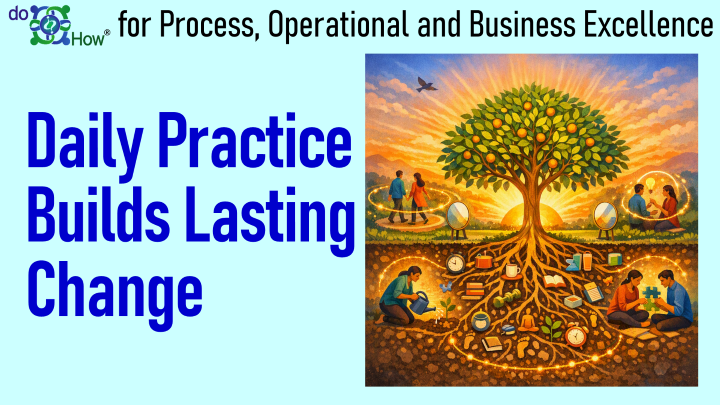
Last week, while reflecting on the identity of leaders of leaders building organisations, I was reminded of a simple truth from my own journey as a Transformation Mentor: identity gives direction, but daily practice gives strength. A seed does not become a tree because we admire it once. It grows because it receives water, sunlight and care every day. In the same way, lasting change in people and organisations is not created by occasional effort, one inspiring programme or a powerful presentation. It is created when we deliberately practise the right thoughts, actions and reviews until they become our natural way of working.
- Easily Visible Symptoms When Daily Practice Is Weak
When daily practice is weak, the signs are visible in ordinary working life. People may know what is right, yet not do it consistently. Teams may discuss improvement, but old habits continue like weeds growing again after a light rain. The organisation may appear busy, but the same issues keep returning.
- Commitments are made but not followed through, so trust slowly weakens.
- Training is attended but not practised, so knowledge remains unused.
- Problems are solved temporarily, but the same fire returns again.
- Reviews become reporting meetings, not learning conversations.
- People work hard but feel tired, because effort is not converted into capability.
At a personal level, I also have to look honestly at myself. Did I only speak about discipline, or did I practise it today? Did I only expect accountability from others, or did I apply it to myself first? The real gap is often not between ignorance and knowledge. The real gap is between knowledge and daily practice.
- Systems and Culture That Create These Symptoms
Over the years, I have learnt not to blame people too quickly. People normally behave according to the system around them. If a system rewards only urgency, people wait for urgency. If leaders appreciate heroic firefighting more than quiet prevention, firefighting becomes the culture. If feedback is treated as criticism, people hide problems instead of learning from them.
Culture is like soil. If the soil is weak, even good seeds struggle. In organisations, the soil is made of daily routines, review habits, leadership behaviours, clarity of expectations and the way mistakes are handled. When these are weak, people may have good intentions, but better habits do not take root.
- When missed commitments are ignored, the system teaches that promises are flexible.
- When explanations are accepted without learning, the system teaches defence instead of improvement.
- When improvement is done only during special drives, the culture treats excellence as an event.
- When leaders do not practise what they ask from others, the organisation hears the speech but follows the behaviour.
This is why daily practice matters deeply. Lasting change comes from consistent daily practice, not occasional effort. Deliberate repetition, reflection and feedback transform knowledge into habits. Habits strengthen culture. Culture strengthens capability. Capability creates sustainable value for customers, employees, organisations and society.
- doHow® Developer to Address the Root Causes
Conventional approaches encourage practice through training, coaching and improvement programmes. These are useful, but they may become like watering a plant once a month. The doHow® Developer can make practice more regular by bringing guided reflection, deliberate practice, mentoring and continual reinforcement into the normal flow of work.
- Daily guided reflection: Ask simple questions at the end of the day so people learn from real work, not only from classrooms.
- Deliberate practice: Choose one useful behaviour and repeat it consciously until it becomes natural.
- Mentoring conversations: Use questions more than instructions, so people develop ownership.
- Feedback loops: Convert mistakes into learning before they become repeated losses.
- Accountability routines: Review commitments respectfully, so accountability becomes trust-building, not fear-building.
The maturity question I must ask myself is: Did I deliberately practise what I know today, strengthen productive habits, learn from feedback and reflection, remain accountable for continuous improvement, and consistently reinforce behaviours that create lasting positive change? This question is like a mirror. It does not ask whether I was busy. It asks whether I became better.
The practice homework is equally simple and powerful. At the end of today, I can pause and reflect: Did I practise what I know? Did I strengthen a mindset and culture that support right daily choices? Did I replace one old habit with a better one through repetition? Did I learn from feedback and reflection to reinforce what works? Did I remain accountable for practising what truly matters until transformation becomes my natural way of working?
When this becomes a daily rhythm, business outcomes improve. Delivery becomes more predictable. Quality improves because process discipline becomes visible. Safety improves because risks are noticed earlier. Customer trust grows because promises are kept. Employees also benefit personally. They become more confident, less reactive and more capable of shaping their own future.
- Key Takeaways
- Knowledge becomes useful only when it is practised.
- Daily repetition converts good intentions into reliable habits.
- Reflection and feedback turn mistakes into improvement.
- Systems and culture decide whether good habits survive.
- Lasting prosperity is built by ordinary people practising ordinary things extraordinarily well.
- An Invitation to Think and Act
For me, transformation is not a loud event. It is more like sharpening a tool every day. A blunt tool makes even simple work difficult. A sharp tool makes difficult work possible. In the same way, daily practice sharpens our thinking, strengthens our habits and prepares us to create value with less struggle.
Before today ends, I must therefore ask myself quietly: What did I practise today that should become part of my nature tomorrow? If I can answer that question honestly, change has already started. If many people in an organisation ask and act on that question every day, lasting change is no longer a dream. It becomes the organisation’s way of life, and that is the true foundation of sustainable prosperity.
Happy reading!
Touches daily life practises & nourshies true culture buliding