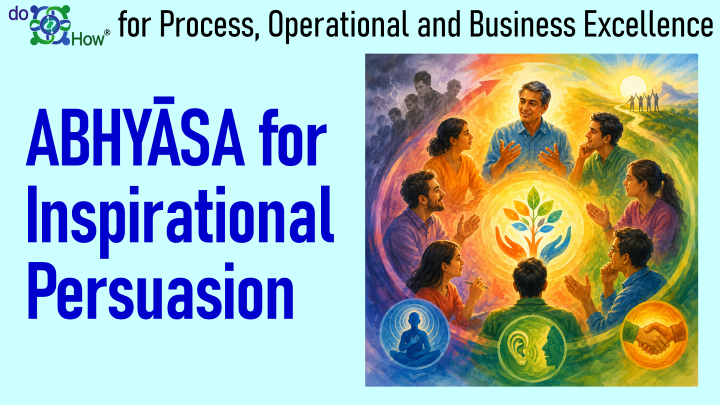
Last week, when I wrote about daily practice building lasting change, I was really speaking about a simple truth I have seen again and again: change does not stay because we understood it once; it stays because we practise it daily. B04. ABHYASA for Inspirational Persuasion is the next natural step in that journey. If daily practice is the watering of the plant, inspirational persuasion is the fragrance that begins to spread when the plant becomes healthy from within.
In my work as a Transformation Mentor, I have observed that people are rarely moved by pressure for long. They may obey for some time, but they commit only when they feel respected, heard, and connected to a meaningful purpose. Inspirational persuasion is not clever speaking. It is disciplined inner practice expressed through respectful outer behaviour. In the doHow® sense, ABHYASA becomes a maturity pathway: Awareness, Belief, Honesty, Yearning, Action, Study, and Alignment. It begins with seeing reality clearly, grows into the belief that a better way is possible, demands honesty about where we truly stand, awakens a yearning to improve, becomes visible through action, is corrected through study, and finally matures into alignment between thought, word, and behaviour.
Visible symptoms when B04. ABHYASA is weak
When this maturity is weak, the symptoms are visible in ordinary conversations. Meetings become like crowded traffic junctions where everyone is moving, but no one is truly guiding the flow.
- People react quickly, but understand slowly.
- Team members speak to prove a point rather than to solve a problem.
- Feedback is either avoided to protect relationships or delivered harshly to prove accountability.
- Meetings end with agreement in the room, but weak action outside the room.
- Trust reduces, small misunderstandings grow, and collaboration becomes mechanical.
The business impact is serious: slower decisions, repeated follow-ups, hidden resistance, poor ownership, and lost value. The personal impact is equally painful: strained relationships, emotional tiredness, defensive behaviour, and the quiet feeling that people are working together without really being together.
Systems and culture behind these symptoms
I have learnt not to blame people too quickly. As my mentoring experience repeatedly reminds me, people are not usually the root problem; they are often reflecting the system around them. When organisations reward speed more than understanding, people interrupt. When leaders value obedience more than learning, people remain silent. When review systems focus only on targets and not on thinking quality, communication becomes a performance, not a practice.
In many workplaces, communication training teaches people what to say, but daily routines do not help them practise how to become the person who can say it with awareness, respect, and courage. It is like polishing the horn of a vehicle while ignoring the condition of the driver. The sound may become sharper, but the journey is still unsafe.
The culture behind weak inspirational persuasion usually has a few common roots: unclear expectations, low psychological safety, poor listening habits, fear of disagreement, weak reflection after conversations, and lack of disciplined reinforcement. In such a culture, people may get stuck at only partial maturity. They may have awareness of problems but no belief that change is possible, or belief without honesty, or honesty without the yearning and action needed to improve. Without daily Abhyāsa, even good people fall back into old reactions.
doHow® Developer for Inspirational Persuasion
The doHow® Developer approach deepens maturity by converting good intention into daily habit. Conventional training may improve communication style, coaching may improve confidence, and feedback may correct mistakes. But daily Abhyāsa makes inspirational persuasion natural. It slowly changes the person behind the words by helping the leader travel again and again through the inner cycle of seeing, believing, facing truth, wanting better, acting, studying, and aligning.
- Guided reflection: After important conversations, leaders reflect on what they thought, felt, said, and caused.
- Deliberate practice: Teams practise respectful listening, constructive disagreement, and purpose-based communication in real work situations.
- Mentoring conversations: Leaders are supported to see patterns, not merely events; causes, not only symptoms.
- Feedback loops: Outcomes of conversations are reviewed so people learn whether their words built trust or created distance.
- Continual reinforcement: Small daily reminders help people align thought, word, and action until trust-building becomes a habit.
For me, the most powerful question is not, “Did I speak well?” The better question is, “Did my communication help others think better, feel respected, and act with greater ownership?” This changes persuasion from a technique into a service.
In this way, ABHYASA is not just a word; it is like a staircase inside me. Each step prepares the next. Awareness without belief becomes helpless observation. Belief without honesty becomes imagination. Honesty without yearning becomes dry analysis. Yearning without action becomes wishful thinking. Action without study becomes repetition. Study without alignment remains intellectual learning. Only when all seven come together does persuasion become inspirational, trustworthy, and value-creating.
Through this pathway, the doHow® intervention does not merely teach people to communicate better; it helps them become more worthy of being listened to. That is the deeper maturity required for sustainable prosperity.
Practice homework to internalise the wisdom
This week, I invite you to practise a simple daily homework. At the end of each day, you will reflect on today’s conversations and ask:
- Did I first become aware of my thoughts before responding?
- Did I keep my belief alive that a better response was possible?
- Did I honestly see how my behaviour may have looked to others?
- Did I feel a genuine yearning to improve the quality of the relationship?
- Did I choose a constructive action instead of a habitual reaction?
- Did I study the outcome through reflection and feedback?
- Did I align my thoughts, words, and actions so that every interaction built greater trust?
This is not homework for the mind alone. It is homework for the heart, tongue, and hands. When practised daily, it becomes like tuning a musical instrument. Slowly, the same person produces a different sound: calmer, clearer, kinder, and more trustworthy.
Key takeaways
Inspirational persuasion grows through disciplined practice, not occasional motivation.
Awareness prevents reaction from becoming damage.
Belief keeps alive the possibility that conversations can become better.
Honesty helps us see how stakeholders may experience our words and behaviour.
Yearning converts discomfort into a sincere desire to improve.
Action makes intention visible through respectful listening and constructive speaking.
Study converts every outcome and feedback into learning.
Alignment makes trust visible when thoughts, words, and actions move together.
Prosperity is not built only in boardrooms, machines, systems, or strategy documents. It is also built in the quality of everyday conversations. One respectful response can prevent a conflict. One patient question can open thinking. One honest reflection can improve tomorrow’s behaviour. Like a lamp lighting another lamp without losing its own flame, inspirational persuasion spreads value when it is practised with awareness and humility.
So today, before you try to persuade anyone else, you will pause and ask yourself: Am I merely trying to win the conversation, or am I practising in a way that helps people trust more, collaborate better, decide wiser, and act with shared purpose?
Happy reading!