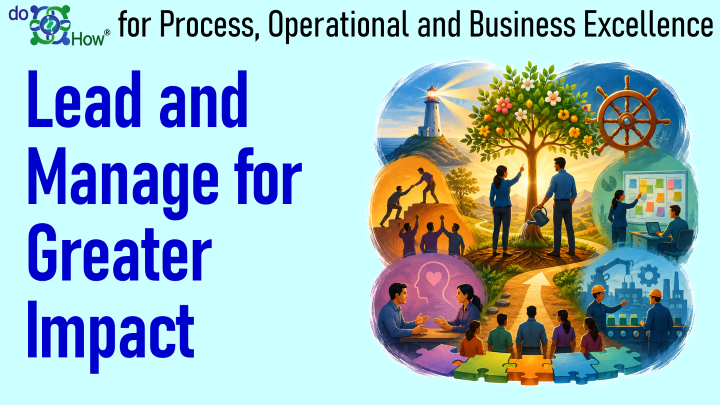
Last week, when I wrote about B04. ABHYASA for Inspirational Persuasion, I was reflecting on how inner practice becomes visible as respectful influence. If persuasion is the fragrance of a healthy plant, then B05. Lead and Manage for Greater Impact is the careful gardening that keeps the plant growing, flowering, and giving fruit. In my work as a Transformation Mentor, I have repeatedly seen that people do not grow merely because we inspire them, and results do not sustain merely because we control them. Prosperity needs both: leadership that gives meaning and management that gives discipline.
Many organisations suffer because these two are separated like two wheels of a bullock cart moving in different directions. Leadership talks about vision, motivation, empowerment and growth. Management talks about plans, targets, reports, reviews and accountability. But in real daily work, people need both together. Purpose without discipline becomes excitement without dependable results. Discipline without purpose becomes pressure without innovation. When both come together, people feel respected, work becomes clearer, decisions become faster, and execution becomes more predictable.
Easily visible symptoms when Leading and Managing is weak
When Leading and/or Managing is weak, the symptoms are not hidden. They appear in meetings, reviews, shopfloor conversations, customer commitments and even in the silence of people who have stopped expecting improvement.
People work hard but do not feel deeply connected to purpose.
Managers give tasks, but do not understand the person behind the task.
Delegation is given without enough clarity, authority or accountability.
Reviews become fault-finding sessions instead of learning conversations.
Some teams show enthusiasm, but outputs are inconsistent.
Some teams deliver routine numbers, but new ideas and ownership are missing.
High performers become overloaded, while others remain under-developed.
Trust slowly reduces because promises, follow-ups and consequences are not balanced.
The business impact is visible as delayed decisions, repeated firefighting, weak accountability, poor productivity, customer dissatisfaction and loss of sustainable value. The personal impact is equally serious: tired leaders, confused team members, lower confidence, hidden frustration and a feeling that work is only pressure, not progress.
Systems and culture behind these symptoms
I have learnt not to blame people too quickly. As a Transformation Mentor, I see that every organisation is a mirror of the habits, thinking and decisions of its people. Sustainable transformation does not come by demanding more effort alone; it comes by improving clarity, capability, discipline and purpose.
In many workplaces, people are measured only through recent results. A person becomes a number, a delay, a complaint, a mistake or a target. But human beings are not machines with only output meters. They have motivations, values, family pressures, fears, aspirations, pride, learning styles and unspoken doubts. If I understand only the result and not the person, my support becomes mechanical.
Sometimes leadership is taught separately in one training room and management is taught separately in another. But daily work does not respect such separation. A supervisor cannot inspire on Monday and manage only on Tuesday. A plant head cannot talk of purpose in the annual meeting and ignore for disciplined execution in the daily Genchi Gembutsu and Genjitsu. Leadership is the compass; management is the road map. One shows direction. The other ensures that we actually move.
doHow® Developer for Leading and Managing
Conventional approaches try to improve leadership and management through training, coaching and feedback. These are useful, but often not enough. The doHow® Developer strengthens both through daily guided reflection, deliberate practice, mentoring and continual reinforcement. It helps leaders practise small behaviours repeatedly until balanced leadership becomes a natural way of working.
Daily reflection: Ask whether I understood my people beyond their role, task and latest result.
Personalised support: Notice each person’s motivation, values, aspirations and working style.
Purpose connection: Help people see how today’s work connects with their meaningful growth.
Balanced reviews: Review both effectiveness and efficiency, not only activity completion.
Delegation with accountability: Increase responsibility only with matching clarity, authority, capability and consequence.
Mentoring through questions: Use thoughtful questions to awaken ownership instead of giving ready-made answers.
To make this practice even more useful, I use a few simple questions as gentle hints. While preparing a report, the team member can ask: What changed since the last report? Why is there a trend and/or target gap? What needs to be done? What support is needed? What should we expect by our next meet? These questions convert reporting from a backward-looking statement into a forward-moving commitment, with natural thinking.
Similarly, during daily, weekly, monthly or quarterly steering meetings, the review can become a learning mirror with the leader engaging in a conversation for thinking by asking: What did you expect? What actually happened? Why was it wrong or correct? What was missed or followed? What will you change or continue? These questions protect dignity because they focus attention on expectation, reality, causes, routines and improvement instead of blaming the person.
The simple homework for internalising Leading and Managing is this: at the end of today’s work, pause for a few minutes and ask, “Did I truly understand my people beyond their roles, tasks and recent results? Did I personalise my support? Did I strengthen trust? Did I connect today’s work with their growth? Did I balance leadership for effectiveness with management for efficiency? Did I avoid creating either enthusiasm without dependable results or dependable results without enough innovation? Did I match increasing delegation with increasing accountability?”
This reflection may look small, but it is like sharpening the axe before cutting the tree. Without reflection, leaders become busy. With reflection, leaders become better. The doHow® way is not to wait for a big programme to change culture. It is to convert ordinary work into a daily practice ground where people, process and purpose become aligned.
Key takeaways
Leading inspires purpose, growth and commitment.
Managing ensures discipline, follow-up and dependable execution.
People must be understood beyond performance numbers.
Support becomes powerful when it is personalised to the person, not generalised to the role.
Delegation without accountability creates confusion; accountability without support creates fear.
Balanced leaders improve both people and performance, both effectiveness and efficiency.
Sustainable prosperity is created when daily practice becomes culture.
Every leader leaves a shadow. In that shadow, people either shrink or grow. They either wait for instructions or take ownership. They either protect themselves or contribute courageously. The question is not whether we are leading or managing. We are always doing both, even when we are unaware. The real question is whether our leadership is creating meaning and whether our management is creating dependable progress.
For me, B05. Lead and Manage for Greater Impact is not a management topic. It is a prosperity discipline. When I understand people beyond results, support them with care, guide them with purpose, review them with discipline and trust them with accountable responsibility, I am not merely improving performance. I am helping ordinary people become more confident, capable and valuable. And when many ordinary people consistently do ordinary things extraordinarily well, an organisation quietly begins its journey from survival to sustainable prosperity.
Happy reading!