
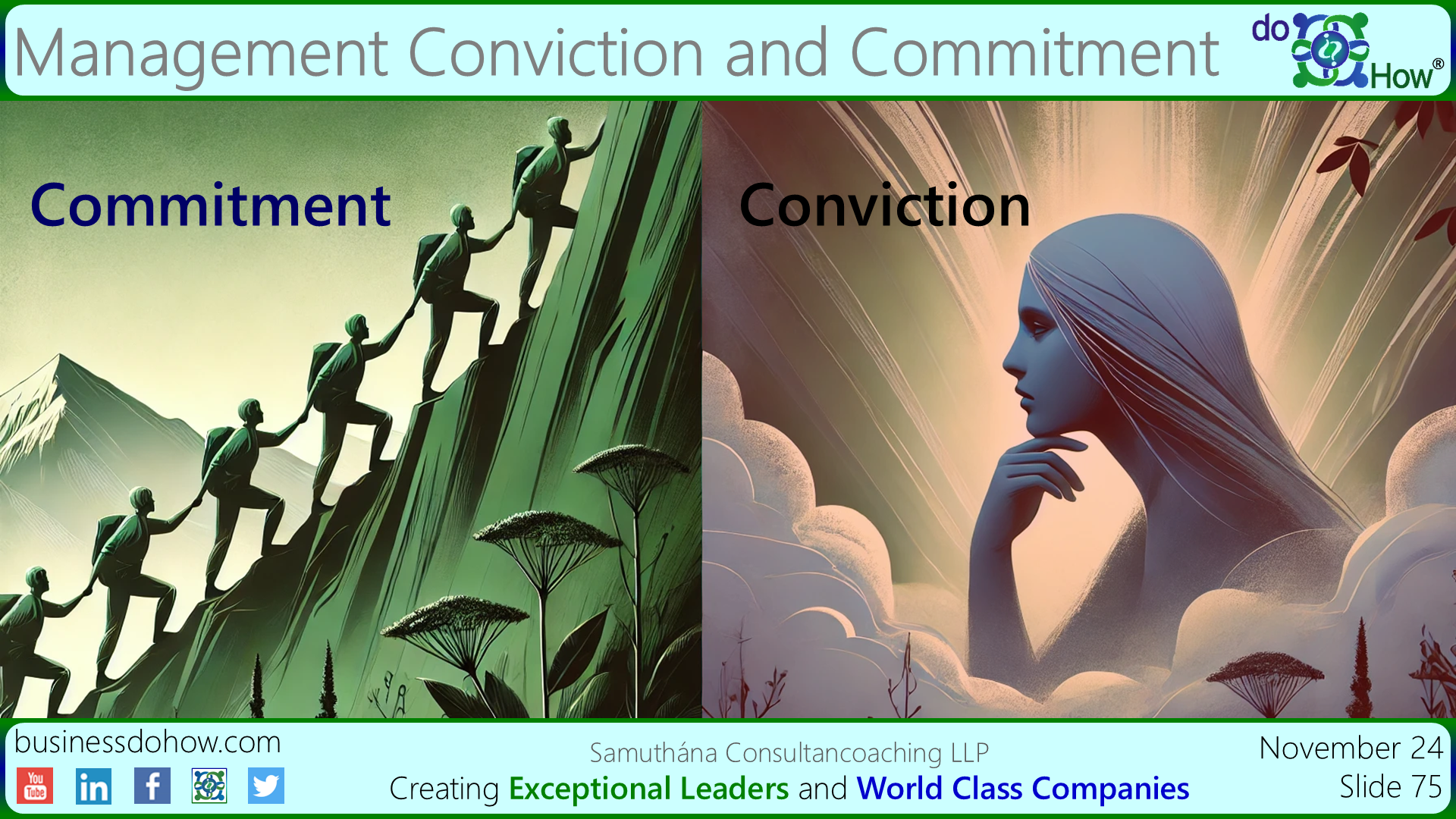
In the realm of organizational transformation, improvement, and innovation, one truth stands unchallenged: the success of any initiative hinges on management commitment. Like the foundation of a skyscraper, it either supports monumental success or causes the entire structure to collapse when compromised. This single factor has the power to propel organizations toward greatness or doom them to mediocrity. So, why is it that so many leaders with strong conviction fail to deliver the outcomes they desire?
Having worked with hundreds of Owners, CEOs, and CXOs, I can confidently say that almost all leaders genuinely believe in change. Their conviction is unshakable. Yet, paradoxically, when transformation efforts falter, management commitment—or the lack of it—emerges as the root cause. This paradox is not just puzzling; it’s devastating. It’s the difference between being a passionate supporter of a marathon and actually running it—the implicit conviction versus the explicit commitment.
This begs the question: Why does strong conviction fail to translate into impactful commitment? To answer this, we must examine the fatal flaws that undermine management commitment, each one a crack in the foundation of change.
- Too Many Fires, Too Little Focus
Imagine a captain launching ten ships at once, only to watch half of them sink because they lacked direction. This is precisely what happens when organizations undertake multiple parallel initiatives—ERP implementation, Lean Manufacturing, Leadership Development, Policy Deployment—all at once. The overwhelming number of initiatives creates confusion and dilutes focus, leaving teams disoriented. The management’s commitment to each project gets lost in the noise, camouflaged by the sheer volume of activities.
- The Outsourced Savior Syndrome
Another common misstep is the delegation of the entire transformation process to a “change agent.” Leaders, expecting the change agent to rally the troops, shift mindsets, and overhaul the culture, step back and become passive observers. This abdication of responsibility signals abandonment rather than support. It’s like handing over the wheel of a car and expecting someone else to navigate the storm without your input. Unsurprisingly, the outcomes in such scenarios are often disappointing.
- The ‘How’ Trap
Leaders who obsess over the “How” of transformation while neglecting the “Why” and “What” inadvertently create a fog of uncertainty. Detailing the mechanics of change is important, but without a clear understanding of its purpose and desired outcomes, the effort feels like assembling a jigsaw puzzle without knowing what the final image should look like. This lack of clarity undermines progress and causes teams to lose sight of their goals.
- The Vanishing Act
Leadership visibility is critical for any transformation to succeed. When management becomes “too busy” to review progress or steer the change process, it’s akin to a lighthouse switching off during a storm. The team, left to navigate in the dark, struggles to maintain direction. Consistent involvement and engagement from leadership are vital signals of commitment, and without them, change efforts often drift off course.
- Feedback: The Mirror Leaders Avoid
Sometimes, the biggest barrier to change is management itself. Leaders unwilling to accept feedback or reflect on their actions act as roadblocks to progress. Feedback is like a mirror—it reflects what needs to be changed—but many leaders avoid looking into it. Actively seeking feedback and addressing shortcomings is essential for removing barriers to change. Without this willingness to adapt, even the most well-intentioned initiatives can stall.
- Starving the Change Beast
Driving transformation without sufficient resources is like attempting to cross a desert without water. Resources—whether financial, human, or technological—are the lifeblood of change. Leaders who fail to allocate adequate resources effectively sabotage their own efforts. This insufficiency leaves teams overwhelmed, overburdened, and ultimately unable to deliver the desired outcomes.
- The Fear of Conflict
Avoiding conflict may seem harmonious, but in reality, it stifles innovation and progress. Leaders who shy away from healthy debates and dissenting opinions create an environment where issues aggravate and commitment to change wanes. Embracing constructive conflict is essential for genuine commitment and growth. During any change conflicts are a normal byproduct, which need to be addressed effectively for creating an even better solution—the third alternative.
- The Accountability Avoidance
When leaders fail to hold themselves and their teams accountable, commitment to change becomes superficial. Without accountability, initiatives lose momentum, and desired outcomes remain out of reach. Establishing a culture of accountability is crucial for sustaining commitment and achieving transformation goals. The regular reinforcement of the roles and accountability is integral to any change process, making the establishment of accountability almost mandatory.
A Personal Reflection on Commitment
Let me now share an example from my career where conviction translated into impactful commitment.
In 2001, while at Bosch in Germany, I witnessed firsthand what true management commitment looks like. I was tasked with implementing advanced manufacturing technology across 25 plants worldwide—a daunting challenge requiring collaboration between traditionally competing parties. My boss at the time, the late Dr Ulrich Dohle, exemplified the gold standard of management commitment.
Dohle didn’t just delegate; he engaged actively. He held weekly one-on-one discussions with me, listening my plan—the “How”, tweaking from his experience, allowing me to deploy and conducted quarterly reviews with the top leadership team to ensure alignment, accountability, and momentum. He allocated a separate revenue budget for this initiative and sanctioned additional resources, including expert support in the plants. Importantly, he clarified the purpose and expected outcomes of the initiative, focusing on the “Why” and “What” rather than just the “How.”
Thanks to this unwavering commitment, we achieved our goals within 18 months—a testament to what is possible when management truly walks the talk.
Conclusion: Are You Leading or Watching?
Management commitment is not about launching initiatives, nodding in meetings, or delegating tasks. It’s about showing up consistently, providing resources, seeking feedback, and leading by example. Like a marathon runner, true leaders lace up their shoes and hit the pavement—they don’t just cheer from the sidelines.
Are you leading the charge, or are you simply watching from the sidelines?
Happy reading!
Hello!
Good cheer to all on this beautiful day!!!!!
Good luck :)
Congratulations on crafting such an exceptional article! It is lucid, concise & packed with meaningful insights that are both practical &impactful.
Your writing clearly conveys the essence of true management commitment, making it a valuable resource for anyone aiming to drive successful transformations. Love your useful pieces which are adding value to so many entrepreneurs!
Thanks Dinakar for sharing the perspectives. Most of the points – I agree. However, both leader’s commitment & organization’s purpose & the environment-atmosphere it operates – are also to be considered, besides the landsacpe. Regards.