Over the past few weeks, I have been sharing my reflections on how readiness—emotional, cognitive, and technical—shapes the quality of our professional and personal lives. With last week’s article, The Power of Methodologies doHow®, I completed a deep dive into the doHow® Readiness Assessment. Today, I want to share something very close to my heart: what I have personally experienced while conducting the doHow® Readiness Assessment Workshops across large world-class companies and small growing organisations.
What I discovered surprised me, challenged me, and strengthened my belief in why readiness matters more than we think.
The First Realisation: A Tale of Two Worlds
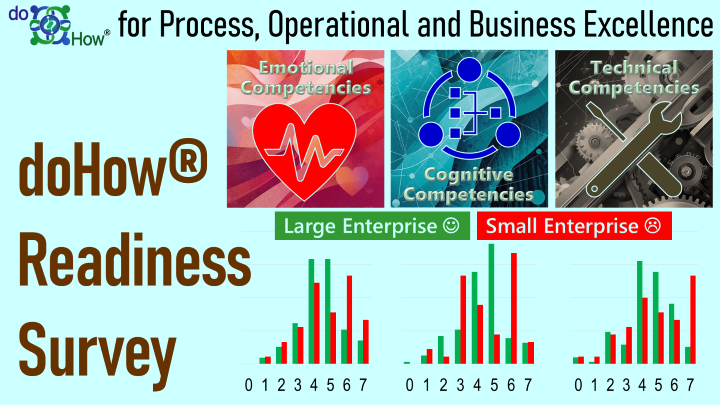
Right at the outset, I want to share an interesting insight from our assessment data, represented in the pictorial. When participants perform a self-assessment of their doHow® Readiness Level (from 0 to 7), large world-class companies (Green Columns) consistently show an almost perfect normal distribution. People see themselves realistically—some low, many in the middle, some high. Exactly the way a healthy system should look.
But in small companies (Red Columns), the self-ratings paint a very different picture. The distribution is either highly skewed or bimodal—clusters of people at very low levels and clusters at very high levels, with very few in the middle. It almost feels like two different realities inside the same workplace.
Why?
I will come to that—but first, let me walk you through how these workshops unfold.
How the Workshop Creates Awareness
Every readiness workshop follows a simple, structured, and eye-opening flow. We start by introducing:
- Our doHow® value proposition—why readiness matters not just for performance, but for fulfilment at work.
- Competency models—briefly touching upon global frameworks before arriving at why doHow® works best for everyday use .
- The doHow® Maturity Scale and the hierarchy levels—explaining what maturity looks like for each role.
- Target maturity levels—what a functional leader, manager, or team member ideally needs.
- Anonymous readiness self-assessment—the turning point of the workshop.
- Conclusion and feedback—where the conversations get deeply honest.
As we move through these steps, I explain a very important truth:
Most of the stress, frustration, conflicts, and lifestyle issues we experience come from operating at a maturity level lower than what our role actually demands.
When this clicks, I can almost feel the energy in the room shift.
The Core of the Workshop: Understanding Competencies
We then explore the three dimensions of readiness using simple language so everyone—from shop floor to top floor—can relate.
- Emotional Competencies
Understanding yourself, managing emotions, staying motivated, empathising, and building relationships. These form the human foundation for teamwork.
- Cognitive Competencies
Planning, thinking critically and creatively, understanding systems, leading teams, and delivering flawlessly. These are central to professionalism.
- Technical Competencies
Creating value, streamlining processes, following standards, building ecosystems, and applying methodologies. These drive excellence.
Participants work in small groups to identify the target maturity level for a functional leader. This discussion is always rich. People reflect, debate, share stories, and discover what they earlier didn’t notice. In most workshops, the teams correctly identify the target maturity levels, which shows that people actually know what is expected of them. But only a few honestly recognise where they personally stand and take proactive steps to grow. That is why, when I reveal the recommended levels, many participants nod—some with relief, because it confirms their understanding, and some with surprise, because it opens their eyes to a gap they had not noticed before.
Then comes the anonymous survey. People assess their own maturity levels privately. We quickly debrief the results. This part is powerful because the data exposes perception gaps that people were unaware of until this moment.
And almost always, the workshop ends with very positive feedback. Participants appreciate the simplicity, the honesty, and the immediate clarity they gain.
So Why Are the Readiness Perceptions So Different?
After conducting these workshops across many organisations, here is my analysis of the contrasting outcomes.
- Realistic vs Illusionary Self-Perception
In large world-class companies, people see themselves with humility and realism. The culture encourages honest feedback, exposure to best practices, and continuous learning.
In small companies, many individuals believe they are at the top—even without exposure to world-class standards. This creates an illusion of maturity rather than real readiness.
- “I Am OK, You Aren’t” Mindset
The assessments in large companies show a healthy spread—people recognise where they need to grow.
In small companies, the pattern shows something worrying:
a strong psychological bias where individuals rate themselves high while assuming others are the problem.
This blocks teamwork and growth.
- Lower Cognitive Maturity in Small Companies
Small companies often struggle with planning, system thinking, and structured execution. This isn’t due to lack of talent—it’s due to lack of exposure. People do their best with what they know, but they simply haven’t seen world-class workplace discipline.
- Lower Technical Maturity in Large Companies—For the Right Reason
This may sound surprising, but people in large companies often rate themselves lower in technical areas.
Why?
Because they constantly benchmark themselves with global leaders and follow a continual improvement culture.
The more you know, the more you see what you don’t know.
- High Emotional and Cognitive Overconfidence in Small Companies
In small companies, I repeatedly meet a group of people who genuinely believe they operate at the highest maturity levels. But in reality, this overconfidence leads them to blame others for poor results, instead of reflecting on their own gaps.
They expect “magical outcomes”—the kind naturally seen only in world-class companies—without understanding the readiness required to create them.
This contrast between honest self-awareness and illusionary confidence is the main reason why many small companies struggle to grow consistently.
A Gentle But Powerful Realisation
Through these workshops, I have come to understand one universal truth:
Readiness is not about how good we think we are—it is about how well we match the maturity required for the role we occupy, as expected by all the stakeholders.
When that alignment is missing, people feel stress.
When it is present, people feel empowered.
If you want clarity about your own readiness—your strengths, your blind spots, and the level required for your role—I invite you to take the doHow® Readiness Assessment.
It takes only a few minutes. But the self-awareness it creates can stay with you for years.
Happy Reading!
Well said Mr.Murthy. Most of the small organizations struggle with issues mentioned. I would like to add one other point here – people do lack ownership irrespective of the size of the organization. This reflects lack of commitment and performance issues.